

Invest in your future
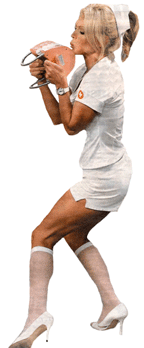
Imagine a world in which Kelly Ripa would not joke--repeatedly--to her millions of TV viewers that she would be Regis Philbin's "sponge bath nurse" in her "little nursey costume." What would that be worth to you?
What about a world in which nurses' views are as respected as much as those of physicians and other professionals in your workplace and community?
Nursing's image matters. In fact, we believe that many of the deepest problems nurses face today--including short-staffing--stem in large part from the undervaluation of nursing.
Why? Because our social and media environment is still dominated by easy stereotypes about nursing. You know them: the naughty nurse, the handmaiden, the unskilled angel. Advanced practice nurses, when they are not ignored, are often seen as physician substitutes with rudimentary skills.
Too many people just do not understand what nurses do.
We want to change all that. But we need your help.
Let me explain why your support for the Center for Nursing Advocacy can help nurses deliver the care their patients need. Not just today, but in the decades to come.
Global health depends on nurses using their advanced skills to save lives and improve patient outcomes. It's challenging and important work. You know that! But few others do. So nursing is drastically underfunded. That starves nurses and their patients of the resources they need.
Why don't people understand nursing?
Work done mainly by women has long been undervalued. Nurses have mainly been viewed as low-skilled physician handmaidens. And social attitudes are hard to change.
These public attitudes about nurses are reflected in the mass media. And the media reinforces the attitudes, in an ongoing cycle.
Public health research shows that the media does affect what we think about health care. This is true even of nurses and their clinical colleagues, to say nothing of impressionable members of the public.
 A 2002 Kaiser Family Foundation study found that one-third of regular viewers of NBC's popular "ER" considered information from the show when making health care decisions.
And a 2000 JWT Communications study found that youngsters' strongest impression of nursing came from "ER." But consistent with ER's physician-centric overall message, study respondents wrongly considered nursing a lowly technical job for girls.
The media affects choices about careers. It affects how government and the private sector allocate clinical, research and education funding. And it affects how society treats nurses on a day-to-day basis. These decisions are central to the nursing shortage and the short-staffing that drives it.
Today, "Grey's Anatomy" and "House" regularly attract over 20 million viewers in the U.S. and many millions more around the world. Then the programs are syndicated and appear on DVD for decades. Their influence on public views, especially those of young people, is huge and undeniable.
Unfortunately, the vision of nursing that shows like these present has virtually nothing to do with how nursing really is. Instead, it is based on damaging stereotypes of nurses as mute, servile physician helpers--low-skilled workers who are mostly irrelevant to serious health care.
Of course, the problem is not confined to hospital shows. Two months ago, Kelly Ripa, of "LIVE with Regis and Kelly," told Regis Philbin, who was facing cardiac bypass surgery, that she would be his "sponge bath nurse" in her "little nursey costume." After Regis's surgery, Ms. Ripa told him on air that "nursey-poo is coming with her sponge."
Even the respected news media, including influential publications like TIME magazine and The New York Times, regularly features articles that undervalue or ignore nurses' contributions. With too few exceptions, these media entities tend to suggest that physicians provide all care that matters.
But the Center for Nursing Advocacy helps nurses improve public understanding of their work, to get more resources for nursing practice, research and education. The result will be a stronger profession, easing the shortage and improving our ability to meet emerging health challenges.
The Center monitors media portrayals of nursing. We give praise and encouragement. But we also explore how the media undervalues nursing. We post provocative analyses on our website, and distribute them in Internet news alerts. We mount campaigns to educate media creators. We encourage the media to use nurses as expert sources. We empower nurses as media advocates. And we spark discussion among nurses, the media, and society.
 We influence the global media. The Center won Media Awards from the American Academy of Nursing in 2004 and 2005. Our work regularly receives extensive press coverage around the world.
In 2004, more than 3000 of our supporters sent letters about a Skechers shoe ad featuring pop star Christina Aguilera in a naughty nurse outfit. The company pulled the ad worldwide.
In 2005, a Center campaign persuaded the U.S. Department of Health and Human Services to change the name of its annual minority health campaign from "Take a Loved One to the Doctor Day" to "Take a Loved One for a Checkup Day," in order not to exclude nursing contributions.
In late 2006, after much effort, the Center placed an op-ed by Columbia nursing professor Kristine Gebbie and me in The Baltimore Sun. Our op-ed argued that there should be a Nobel Prize in Nursing.
But to continue and expand this work, we need your financial support. Our tiny staff works hard--volunteering thousands of hours each year--and our board and advisory panel includes prominent experts on nursing in the media. But as a small 501(c)(3) non-profit organization, our resources are extremely limited.
There is so much more we could do. We want to address more than the fraction of nursing portrayals we can now address. We want to work more proactively with media creators, through training and other resources. We want to reach every health worker, and every health care consumer.
Please make a tax-deductible donation today. Patients need us to build a stronger nursing profession.
Let's work together to improve understanding of nursing. Thank you!
 Sandy Summers, RN, MSN, MPH
Executive Director
Center for Nursing Advocacy
P.S. Donations to the Center mean special benefits. In addition to the option of being listed on our web site donors page, you earn 1 gift point for each dollar donated. Use your points to shop in our virtual store!
You can mail donations to us by check if you would like. Here's the address:
Membership
The Center for Nursing Advocacy
203 Churchwardens Rd.
Baltimore, MD 21212-2937 USA
Thank you for your support!
==========================================================
To change your email address for news alerts, please send your old and new email addresses to info@truthaboutnursing.org
To unsubscribe from news alerts click here:
www.truthaboutnursing.org/cgi-bin/unsubscribe.cgi



Educate the world that nurses save lives!
