

Celebrate Nurses Day!
Join me in changing how the world thinks about nursing
Dear Nursing Supporter,
To celebrate International Nurses Day this year, I urge you to do something that will really advance the profession over the long term: join me and the Truth About Nursing in a major effort to improve public understanding of the value of nursing. We will increase public respect for the profession and enable it to gain the resources needed to meet the challenges we face. Please donate to the Truth About Nursing now.
Today, many direct care nurses are too stretched to give their best care. Many nursing educators struggle for funding. That is unacceptable. I believe it is due in large part to the poor understanding society has about nursing, despite the positive sentiments that the public often expresses about us, particularly as part of Nurses Day celebrations. That lack of true understanding is fueled by enduring stereotypes, particularly the physician handmaiden, that Hollywood and other mass media continue to reinforce. And this undervaluation by decision-makers drives the underfunding and other limits with which we struggle.
Indeed, it is possible that inadequate resources for nursing contributed to the spiraling of the Ebola crisis in Africa. The United States has about 1 nurse for every 100 people, but in Africa, that ratio is about 1:1000. Nursing must be stronger -- everywhere -- so that we can better protect patients in such crises.
When nursing is weakened, patients are at risk. But we can change that. Please read on to learn how you can help.
Nursing has grown, but public awareness has lagged
Throughout my nursing career, I have delighted in seeing the growth and development of nursing education, research, and clinical practice. Today's nurses are autonomous professionals, an increasing number with graduate degrees, who conduct cutting-edge research and save lives everywhere, from teaching hospital ICUs to Ebola tents in Sierra Leone. But despite all our professional milestones, nurses still do not have the power or financial resources we need to save all the lives we are capable of saving.
That situation is not foreordained. It is the result of how nursing is valued.
How the media affects nursing education and practice
I have never met a nursing leader who thought that nursing research, education, practice, or residencies were adequately funded in any setting. And our funding has everything to do with the value that decision-makers and the public place on nursing. But where do decision-makers form key impressions of nursing?
Ninety percent of people say they learn about health care from television, and half of those learn from dramas, including soap operas. Research shows that entertainment television affects not just how people understand specific diseases and procedures, but the roles of health professionals. Health communication research also shows how powerful it is to mix health messages within a fictional plotline, because viewers already care greatly about the characters and their lives.
For my whole life, I have seen fictional nurses depicted as submissive, barely-educated assistants who fetch things for physicians, or even provide them or patients with sex. On television, physician characters tend to get the vast majority of the attention, often performing work that real-life nurses do. Non-fictional media is also deeply flawed. Elite news media sources typically focus on and consult only physicians. And even trusted sources cannot be trusted about nursing. Dr. Phil once stated on air that based on his experience, some nurses were out to "seduce and marry them a doctor, because that's their ticket out of having to work as a nurse."
When many nurses see stereotypical images of nursing, they disregard them and move on. But the public does not disregard these images. Public health research shows that if a celebrity says something, 25% of people will believe it, even if it is wrong. Research by JWT Communications in 2000 showed that school children got their main impression of nursing from television and considered nursing a technical field "for girls." Private school students believed that more was expected of them than to be a nurse. More recent research confirms these basic findings.
In sum, research shows that the media often reinforces damaging ideas about nursing, and that has a real impact. In effect, media that undervalues nursing tells decision-makers that we are not worthy of their funding. That undermines our profession and limits the quality and quantity of the care we can give patients.
My work with Nurses of America
The image of nursing has been a longstanding concern of mine. In the late 1980s, I formed a task force with colleagues called Nurses of America. With a grant from the Pew Charitable Trusts, we evaluated media about nursing, prepared nurses to speak about nursing's value, developed a proposal for a television talk show with nurses as hosts, held luncheons for high-level science writers, and met with editorial boards of major newspapers to discuss nursing's contributions to health care.
When Aaron Spelling's 1989 television show Nightingales appeared -- featuring dimwitted naughty nurses who fawned over physicians -- we set up an in‑person meeting with NBC's CEO to object. He was unconcerned. So we organized a letter-writing campaign, and more than 1,000 nurses and supporters asked advertisers to remove their advertising from the show. It was a successful grass-roots campaign and the network pulled the show after 13 episodes.
That victory was a key early step in empowering nurses to exert more control over their public image. We showed that a group of scholars, organizational leaders, staff nurses, and students could improve how the public perceives nursing.
A diverse coalition of nurses and supporters must come together again to reignite the effort to improve public understanding of nursing. How?
Please support the Truth About Nursing
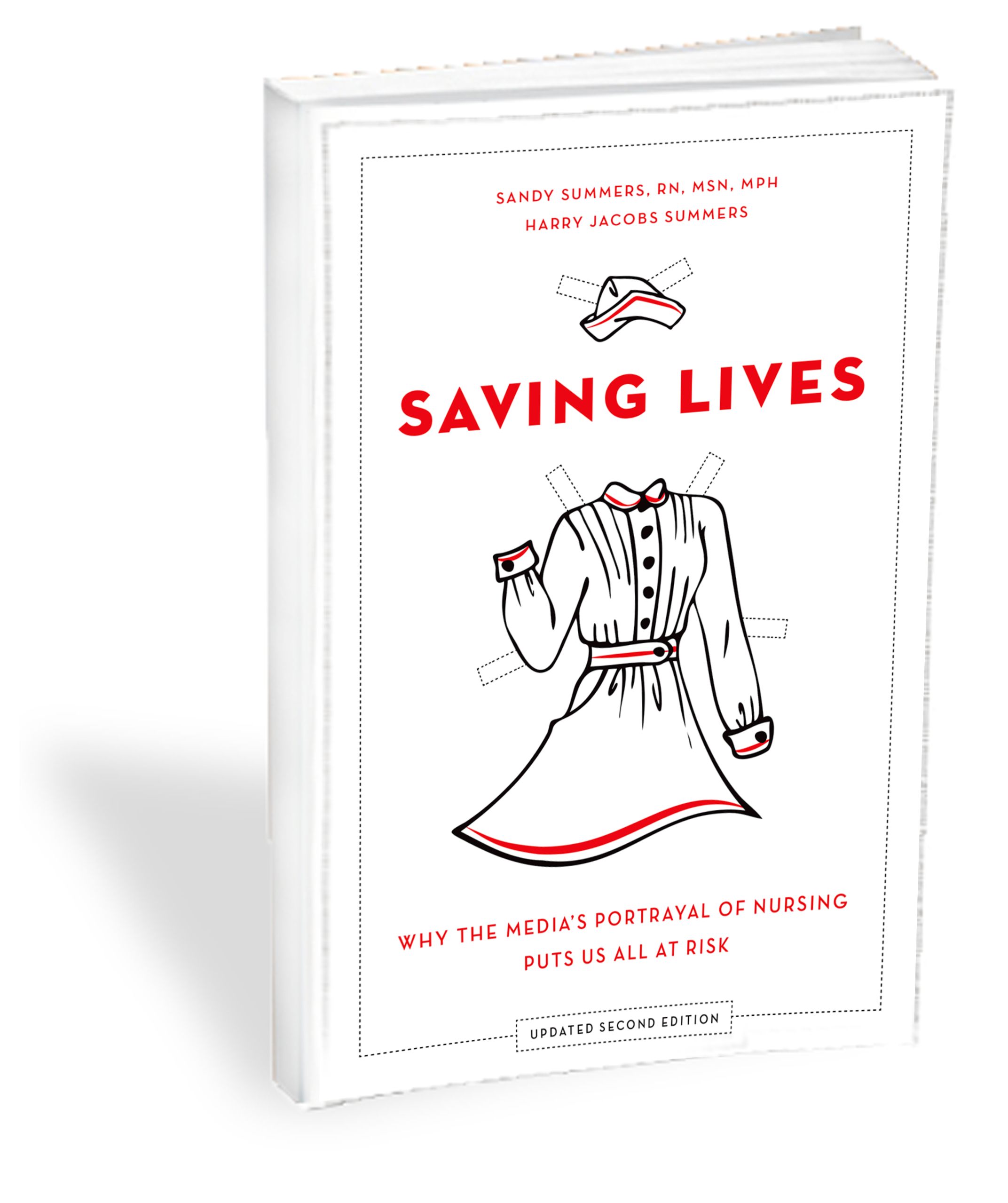
The Truth About Nursing, a 501(c)(3) non-profit, has been at the forefront of more recent efforts to raise awareness about the value of nursing. Sandy and Harry Summers have led this effort since 2001, and I have worked with them to pursue it since 2003. They have spearheaded effective advocacy campaigns from persuading the federal government to change the name of its "Take a Love One to the Doctor" campaign in 2005 to successfully pressuring MTV to make amends for its damaging "reality" show Scrubbing In in 2013. They have assembled a vast website to increase understanding and empower nurses. And they wrote Saving Lives: Why the Media's Portrayal of Nursing Puts Us All At Risk, selected as a 2009 Book of the Year by the American Journal of Nursing. Oxford University Press just published the updated second edition, and I urge you to read it. All royalties go to support the Truth.
The Truth and its leaders have done all this with little funding. Sandy and Harry volunteer all of their time, and they donate all their royalties and honoraria to the Truth. With current financial resources, they are only able to fund one part-time office assistant. [you could do several things with the previous sentence, including omitting it -- I would probably not say we can't even afford an office assistant because it may sound too pathetic] But with sufficient resources they could do so much more.
I am calling on nurses and supporters like you to join the Truth About Nursing in an ongoing supportive role. I hope that you can make a commitment of $___ per year or more, whatever amount is right for you. The Truth has different levels of membership, and any demonstration
of support will be a critical asset to this small but valiant group of nursing advocates.
Imagine a world that values nursing -- then help us make it happen
Imagine what would happen if millions of viewers regularly saw nurses on their favorite TV dramas, making astute assessments and autonomous interventions that saved lives, such as detecting obscure symptoms, rescuing patients in decline, and defibrillating. Imagine what would happen if influential news media sources regularly credited nurses for their work, and consulted nurses about subjects in which they are expert, including nursing research.
Here's what would happen: Decision-makers would feel far more pressure to give nurses the resources they need for education, research, and clinical practice. And nurses would be better able to provide patients with the care they need.
To get there, we must strengthen the Truth's advocacy and education efforts. We would like to form a broader group of supporters to improve outreach, from roundtables joining nursing leaders with Hollywood writers to shadowing programs for media creators and medical colleagues. Of course, it can be difficult to change the deeply held views of those with power. But we can do it if we all work together.
I hope you can make an ongoing commitment to this vital work today. It is time for the profession to enable the Truth to lead a robust advocacy effort that can help us meet our commitment to patients. Here are details about membership. There is more information on this proposed effort at http://bit.ly/fund-the-Truth. [would that link be appropriate for the recipients here? if not, omit sentence]
Please support the Truth About Nursing today. Thank you very much.
All my best,

Claire Fagin, RN, PhD, FAAN
Dean Emerita, University of Pennsylvania School of Nursing
Interim President, University of Pennsylvania, 1993-1994
 Please support The Truth About Nursing
We need your help so we can pursue this mission together. We would be very grateful if you could make a donation--even if it is $5, $10 or $25. Any amount would be so helpful. Please click here to donate. Thank you!
The Truth About Nursing is an international non-profit organization based in Baltimore that seeks to help the public understand the central role nurses play in health care. The Truth promotes more accurate media portrayals of nurses and greater use of nurses as expert sources. The group is led by Sandy Summers, co-author of Saving Lives: Why the Media's Portrayal of Nurses Puts Us All At Risk.
Thank you for supporting the Truth About Nursing's work!
The Truth About Nursing
203 Churchwardens Rd.
Baltimore, Maryland, USA 21212-2937
office 1-410-323-1100
fax 1-410-510-1790
info@truthaboutnursing.org
Please circulate this freely. If this was forwarded to you, you can sign up for free news alerts here: https://www.truthaboutnursing.org/members/news_alerts_signup.html
To change your email address for news alerts, please send your old and new email addresses to info@truthaboutnursing.org
Click here to unsubscribe from news alerts



Educate the world that nurses save lives!
