

Significant unknowns
need sub-head
 November 7, 2014 -- Several recent news items have highlighted the extent to which the media consults nurses for their expertise
in managing serious long-term illnesses. [I wish we could hook people in more strongly here] Sometimes the media's openness to nursing input is impressive. On January 8, 2014, the CNN website posted a thoughtful opinion piece by Johns Hopkins nursing professor
Cynda Rushton on the difficult ethical issues surrounding a Texas woman who was considered brain dead but whose body was being kept alive, against her family's wishes, under a state law requiring that because she was 19 weeks pregnant. And today, the Cambridge News (UK)
ran a short piece by Freya Leng reporting that actress Toni Collette and others involved in making the film Miss You Already had recently consulted two nurses and a physician from Cambridge University
Hospital about their portrayal of a woman whose breast cancer had caused a brain tumor. That item includes quotes from one of the specialist nurses, Ingela Oberg. We thank those responsible for these pieces. But the media often ignores nurses even when they have relevant expertise.
On June 24, 2014, the New York Times published an extensive article by Gina Kolata about long-term acute care hospitals, which care for those whose recovery from long-term illness is unlikely. Although nursing is central to this kind of care, the article does not quote
a single nurse. Instead, we hear from six critical care physicians. It's true that a photo shows a nurse handing a patient a cell phone! But the piece suggests that physicians provide or direct all meaningful care in this setting. We do not object to physicians receiving
this level of attention when the area is one in which they play the central role or are the only experts. But long-term acute care and its ethical implications is a context in which nurses--like Cynda Rushton--are key players. We urge the Times not to assume physicians
are the only experts worth consulting about health care issues.
November 7, 2014 -- Several recent news items have highlighted the extent to which the media consults nurses for their expertise
in managing serious long-term illnesses. [I wish we could hook people in more strongly here] Sometimes the media's openness to nursing input is impressive. On January 8, 2014, the CNN website posted a thoughtful opinion piece by Johns Hopkins nursing professor
Cynda Rushton on the difficult ethical issues surrounding a Texas woman who was considered brain dead but whose body was being kept alive, against her family's wishes, under a state law requiring that because she was 19 weeks pregnant. And today, the Cambridge News (UK)
ran a short piece by Freya Leng reporting that actress Toni Collette and others involved in making the film Miss You Already had recently consulted two nurses and a physician from Cambridge University
Hospital about their portrayal of a woman whose breast cancer had caused a brain tumor. That item includes quotes from one of the specialist nurses, Ingela Oberg. We thank those responsible for these pieces. But the media often ignores nurses even when they have relevant expertise.
On June 24, 2014, the New York Times published an extensive article by Gina Kolata about long-term acute care hospitals, which care for those whose recovery from long-term illness is unlikely. Although nursing is central to this kind of care, the article does not quote
a single nurse. Instead, we hear from six critical care physicians. It's true that a photo shows a nurse handing a patient a cell phone! But the piece suggests that physicians provide or direct all meaningful care in this setting. We do not object to physicians receiving
this level of attention when the area is one in which they play the central role or are the only experts. But long-term acute care and its ethical implications is a context in which nurses--like Cynda Rushton--are key players. We urge the Times not to assume physicians
are the only experts worth consulting about health care issues.
Miss you already
Rushton's CNN op-ed is headlined "Take pregnant woman off ventilator?" She first explains that Marlise Munoz's "body is being maintained with technology after being reportedly declared dead based on neurologic criteria," even though her husband says that is not what she would want, because Texas law requires it when someone in her position is 19 weeks pregnant. Rushton explores the ethical issues in cases where a patient is in this position and there are conflicts among those who remain--family, health providers, the government--about whether to maintain life support. She explains that the interests of mother and unborn child are both at stake in the Munoz case, but people see those interests differently.
As a nurse and clinical ethicist, I have witnessed firsthand the anguish of family members who must make a choice about continuing pregnancies under such uncertain circumstances, or the aggressiveness of treatment for their extremely premature infants.
Rushton provides more questions than answers. She asks whether Munoz's preferences should be "nullified" because she is pregnant, and if so who is responsible for the costs and care until the point of viability, noting that there are "significant unknowns," such as whether the fetus can survive and what its ultimate condition may be. For health care providers, such cases may mean giving treatments and care patients do not want, potentially conflicting with the ethical imperative to "do no harm" and leading to moral distress and burnout. Noting that these cases are heartbreaking and there are "no easy answers," Rushton urges us to "examine again our 'technology default'" (by which she seems to mean the impulse to use technology to the maximum extent possible) and to "accept the limits of what medicine can and cannot do." Although she does not explicitly side with Munoz's family, Rushton does say that "we must consider whether keeping her alive by invoking a state law honors her and her memory."
This piece is helpful because it is a thoughtful, balanced, well-written discussion of some of the wrenching issues involved in the Munoz case by a prominent nursing scholar. By identifying herself as a "nurse and clinical ethicist" who has confronted these issues in practice, Rushton shows readers that nurses are thoughtful professionals whose views are worth hearing. The piece also includes a good photo of Rushton, though we would rather that CNN had used that space for a fuller description of her credentials--she is an internationally-renowned expert in bioethics and palliative care, an RN, PhD with appointments to the Hopkins schools of nursing and medicine. Still, the piece commendably presents a nurse as a health policy leader.
Freya's Leng's Cambridge News item, though very different, is helpful in a similar way. Clearly most concerned with telling local readers that their own Cambridge University Hospitals have been recognized by Hollywood (!), the piece still carefully reports that the hospital's "[n]euro-oncology specialist nurse Ingela Oberg, breast cancer specialist nurse Alison Hallett and cancer consultant Dr Richard Baird provided on-set clinical consultancy to Hollywood actress Toni Collette, during the filming of new comedy drama, Miss You Already." The item explains that Collette plays the character Milly, "whose life is upturned when she develops a brain tumour following the spread of breast cancer." The report says that "Ingela" recently spoke at the Houses of Parliament on the treatment of brain tumors, including the need for better support for young patients leaving the hospital with brain damage. And she gets the only quotes in the short piece:
Toni and the production team were very keen to portray what it's like living with a brain tumour, as accurately as possible. They approached me and asked if I could guide Toni on how her character's behaviour might change, and the kind of challenges she should expect to face with an illness like brain cancer. ... I lost my younger brother to a brain tumour. So improving things for those living with or recovering from brain cancer is something I take very personally.
"Toni"! In addition to Oberg's strong quotes about the nature of her consultancy, we appreciate a nurse who feels secure enough not only to speak to the media, but to refer to a Hollywood star by her given name. In addition, the item is admirably precise about the positions held by the three health professionals the filmmakers consulted, making clear that there are such things as "specialist nurses" and that they have valuable health knowledge. The piece might have also quoted the other two experts consulted, but if there was only room for quotes from one, the apparent match between Oberg and the subject at hand seems to amply justify her selection.
Special care
The same cannot be said for Kolata's choice to quote only physicians in her lengthy Times piece on long-term acute care hospitals, "At These Hospitals, Recovery Is Rare, but Comfort Is Not." In fairness, one of several photos accompanying the piece does show a smiling nurse seeming to hand a cell phone to a patient, along with this caption identifier: "Tammy Bohmer, a nurse, assisting Murray Zack with telephone conversation with his son." But that's about it. The piece focuses on Connecticut's Hospital for Special Care, one of about 400 long-term acute care hospitals in the United States. These are "no ordinary hospitals: Critically ill patients, sometimes unresponsive or in comas, may live here for months, even years, sustained by respirators and feeding tubes." Some will eventually leave; others will not. The hospitals "often are tucked out of sight, and even many doctors do not know they exist." Wow--even physicians don't know? How about the many nurses who actually work at these hospitals?
Never mind--let's consult physicians. "Dr. Paul Scalise, chief of medicine at the Hospital for Special Care," notes that "[p]eople don't want to think about us." Kolata explains that such care is expensive because the population is aging and "doctors are getting better at keeping people alive when they are in intensive care," but those patients may not be able to come off the ventilator, explains "Dr. Judith Nelson, a critical care specialist at Mount Sinai Hospital." Still, the Connecticut facility is pleasant and "[d]edicated doctors and staff tend cheerfully to patients who require nearly constant care, some of whom are managing to make lives for themselves." "Dr. John Votto, the hospital's chief executive," notes that even many of those on ventilators are "quite happy." "Dr. Jeremy Kahn, associate professor of critical care, medicine and health policy in the University of Pittsburgh School of Medicine," says there is no recognized way to measure the quality of long-term acute care hospitals. "Dr. Christopher Cox, a critical care specialist at Duke University School of Medicine," observes that the financial and social burdens on families whose members end up such facilities is "a real tragedy." Kolata focuses on how patients often get to such hospitals, particularly the decision to place them on ventilators in a regular hospital I.C.U. Nelson explains that few physicians discuss the likely consequences or alternatives to that decision, which can lead to further interventions like feeding tubes. "Dr. Shannon Carson, a critical care specialist at the University of North Carolina School of Medicine," has studied family expectations in these situations, and he suggests that there is a disconnect between those expectations and reality, most likely because the ICU physicians are most focused on just keeping the patients alive. But optimism can fade as it becomes clear patients are not regaining function. The article concludes with accounts of life at the Hospital for Special Care. Ventilators are standard, and for many permanent, Scalise says. Some patients find a measure of happiness; one couple met and married at the hospital. Others are less fortunate. An elderly man with A.L.S. (Lou Gehrig's disease) decides to ask staff to disconnect his ventilator and end his life, after speaking with several physicians. There is no indication that nursing input was or would be of value. Nurses do, however, give the man drugs to sedate him before they turn off the ventilator.
The exclusion of nurses from this piece is not just a matter of fairness. While the physicians quoted here have valuable perspectives, to some extent they are outsiders in this process--it is the nursing staff that spends the vast majority of time with and provides the vast majority of care to patients like these. And nursing scholars like Rushton conduct extensive research on the care of patients with serious chronic illness [links?]. Their views would be at least as valuable as those of critical care physicians. But readers of this piece do not get those views. They should.
----
Notes -
Take pregnant woman off ventilator?
By Cynda Hylton Rushton
CNN website
Updated 8:42 PM ET, Wed January 8, 2014
In Texas, 33-year-old Marlise Munoz's body is being maintained with technology after being reportedly declared dead based on neurologic criteria, meaning her brain can no longer keep her body alive and functioning. Her husband said she wouldn't want to be kept alive by medical technology. But state law requires that her body be sustained because she is 19 weeks pregnant.
The issues surrounding Munoz's case are not isolated. In California, 13-year-old Jahi McMath's body is also being maintained with technology. Her family wants to continue keeping her alive even though her doctors consider her legally dead. There are families all over the world who have faced similar wrenching decisions.
For the medical community and families affected in these cases, thorny ethical issues remain unanswered. Conventional wisdom says that the patient has the right to make a decision, but when he or she is unable to, the legal surrogate decides.
With Munoz, there are two lives at stake: hers and that of her unborn child.

Cynda Hylton Rushton
Man wants pregnant wife off life support 01:43
PLAY VIDEO
Some believe that the life of the mother is directly linked to the life of the infant. They are viewed as an inextricable unit; they live and die together. For others, the mother and fetus are viewed as separate beings with independent interests.
As a nurse and clinical ethicist, I have witnessed firsthand the anguish of family members who must make a choice about continuing pregnancies under such uncertain circumstances, or the aggressiveness of treatment for their extremely premature infants.
Generally, under conditions where there is great uncertainty about outcome for either the mother or the infant, we defer to the family to make an informed decision.
Do Munoz's preferences become nullified because she is pregnant? Should Mr. Munoz's request that his wife be allowed to die in a way that is consistent with her wishes be disregarded?
What is the ethical justification of mandating continued treatment that is contrary to the patient's and surrogate's wishes? Does the fetus become a ward of the state and the woman's body merely a biologic incubator for the fetus? Who then is responsible for the ongoing costs and care of the woman's body and the fetus should it be sustained to the point of viability (24 weeks)?
Keep in mind that there are significant unknowns. How would the lack of oxygen or other treatments impact the developing fetus? Even if the fetus could be sustained to the point of viability, complications resulting from dependence on technology, severe disabilities or premature death are quite possible.
Another ethical aspect of this tragic case is the impact on Munoz's medical personnel, who are providing treatments that are not desired by the patient or her surrogate, and who are perceived to sustain death rather than life.
Clearly, the first priority of doctors, nurses and other clinicians is the well-being of their patients. Their mandate is: First, do no harm. They want to help patients and avoid or remove their suffering. Whose interests are they obliged to promote when they have a patient like Munoz?
But medical personnel are not merely mindless robots who implement the decisions of others. They, too, have moral stakes in the process and outcomes of their care. In order for them to do their work with competence, respect and compassion, they must preserve their own sense of integrity.
When doctors and nurses begin to view their actions as causing physical, emotional or spiritual harms to their patients, it causes them moral distress. They begin to wonder: How can I see myself as a good doctor or nurse when I am participating in actions that I perceive as wrong or ethically unjustified? The result is that clinicians can burn out. They become cynical, detached or numb.
There are no easy answers. Cases like Marlise Munoz are always heartbreaking. There are many things that technology in medicine cannot cure or repair. We cannot know whether attempting to sustain her biologic function to support her pregnancy will yield a healthy infant. Using technology is always a double-edged sword; the very technology that creates hope can also create suffering. It is time to pause to examine again our "technology default."
We must engage with our communities about the boundaries of using technology, and what the appropriate interventions are when a person's life is sustained with technology.
Some would argue that the Texas law rightly protects the interests of the developing fetus and restricts the family's choices. Is the state a better guardian for the fetus than his or her biological parents?
We should always have a reverence for life and the ending of life. If there is uncertainty about the degree of brain damage a person has suffered, then it is ethical to use medical technology to keep him or her alive until a better determination can been made.
However, as in the case of Marlise Munoz, we must consider whether keeping her alive by invoking a state law honors her and her memory.
We need to find ways to make decisions that are respectful, fair and promote integrity. We also need to accept the limits of what medicine can and cannot do. The time has come for a new paradigm for ethical practice in health care.
http://www.cnn.com/2014/01/08/opinion/rushton-munoz-case/index.html?hpt=hp_bn7
----
At These Hospitals, Recovery Is Rare, but Comfort Is Not
By GINA KOLATA
JUNE 23, 2014 (in print June 24)
NEW BRITAIN, CONN. -- Propped up in a hospital bed, a 75-year-old man with amyotrophic lateral sclerosis, or Lou Gehrig's disease, must make an agonizing decision. Should he keep struggling until the illness inevitably kills him, dependent on a ventilator, unable to walk or eat or move? Or should he choose a day and a time to have the ventilator disconnected, and die?
The man, who asked not to be identified to protect his privacy, was a patient at the Hospital for Special Care here, one of 400 long-term acute care hospitals in the United States. These are no ordinary hospitals: Critically ill patients, sometimes unresponsive or in comas, may live here for months, even years, sustained by respirators and feeding tubes. Some, especially those recovering from accidents, eventually will leave. Others will be here for the rest of their lives.
These facilities often are tucked out of sight, and even many doctors do not know they exist. This one sits on the edge of a decaying industrial town.
Photo
Fatima Chaudhary, 2, left, and Emery Timms-Bernier, 1, in the pediatric unit of the Hospital for Special Care in New Britain, Conn. Credit Rick Gershon for The New York Times
"People don't want to think about us," said Dr. Paul Scalise, chief of medicine at the Hospital for Special Care. "I don't want to think about us, either."
But more experts and policy makers are likely to have to start thinking about them soon. The cost of long-term acute care is substantial, about $26 billion a year in the United States, and by one estimate the number of patients in these facilities has more than tripled in the past decade to 380,000.
There are two reasons, said Dr. Judith Nelson, a critical care specialist at Mount Sinai Hospital.
The population is aging, increasing the chances of a catastrophic illness like blood sepsis or acute respiratory distress syndrome that eventually may land patients in a hospital like this one. And doctors are getting better at keeping people alive when they are in intensive care. The result is an increase in the number of highly dependent patients who survive the intensive care unit but must remain on a respirator. They cannot go home or to a rehabilitation facility. Many are too sick even for a nursing home. Long-term acute care is "where you go when you survive but you don't recover," Dr. Nelson said.
And yet this Connecticut hospital is not a place of unrelieved misery. The campus is leafy and green, and the windows are wide and filled with sunlight. Paintings by residents and local artists decorate the walls. On nice days patients can visit a landscaped garden along a path of paving stones and lined with respirator hookups.
Dedicated doctors and staff tend cheerfully to patients who require nearly constant care, some of whom are managing to make lives for themselves. Recently two patients with muscular dystrophy, both in wheelchairs, married in the courtyard outside. The bride was given away by her weeping father.
Photo
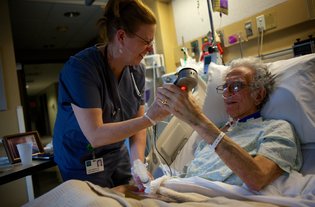
Tammy Bohmer, a nurse, assisting Murray Zack with telephone conversation with his son. The outlook for patients usually isn't hopeful, but the hospital is not a place of unrelieved misery. Credit Rick Gershon for The New York Times
"It's remarkable," said Dr. John Votto, the hospital's chief executive. "You are on a ventilator, you can't move, you can't walk, you can't breathe. You and I would say, 'Oh my God, you must have this terrible quality of life.' But they really don't. Honestly, many are quite happy."
Often they arrive here because ordinary hospitals do not want to keep them. Reimbursement is tied to diagnosis and treatment, but most of these patients no longer need a diagnosis; they need treatment and care. Most start out being covered by Medicare, but when that benefit runs out -- at 150 days -- long-term-care hospitals either discharge the patients anyway or Medicaid usually takes over.
Medicare, concerned about the high price of long-term acute care hospitals, is trying to trim reimbursements. Nearly half of the $7.3 billion cut from its budget by the Affordable Care Act came from reductions in payments to these facilities. Medicare officials argue that perhaps these patients could stay in regular hospitals or nursing homes instead, and say it's unclear whether care is better in long-term acute care hospitals.
But nobody knows what "better" means for these patients, and that makes it difficult to assess how well these facilities are operating.
"We don't know how to measure quality," said Dr. Jeremy Kahn, associate professor of critical care, medicine and health policy in the University of Pittsburgh School of Medicine. "The current Medicare quality measures are borrowed from I.C.U.s. Whether they apply in long-term acute care hospitals is unknown."
The Hospital for Special Care is unusual because 70 percent of its patients are on Medicaid. Yet just 30 percent were on Medicaid when they were admitted, Dr. Votto said. Even with government support, many families are financially devastated when a relative lands in one of these hospitals.
Photo
A ceiling tile above a patient's bed at the hospital was replaced by a scenic image. Credit Rick Gershon for The New York Times
The facility may be several hours from a family's home, so relatives end up staying away from their jobs, living in hotels to be near a parent, child or spouse. Some deplete their life savings. "It's a tragedy, a real tragedy," said Dr. Christopher Cox, a critical care specialist at Duke University School of Medicine. "A heartbreaking situation."
The road to a long-term acute care hospital often starts in an I.C.U. somewhere else when a doctor suggests placing a tube in a patient's throat so he or she can be hooked up to a ventilator. "Once that happens, your future is not bright, unless you are quite young," Dr. Nelson said.
Deciding to have a tracheotomy should be a difficult decision for family members, she added. But, she said, "people misunderstand -- they think it is a sign of hope." Few doctors discuss the likely consequences or the alternatives.
"It could be that physicians are not confident in their prognosis and therefore don't want to share it, or it could be that physicians do share it and families don't want to hear it," said Dr. Shannon Carson, a critical care specialist at the University of North Carolina School of Medicine, who has studied what families expect when a relative enters a long-term acute care hospital.
But the likeliest reason for the disconnect, he said, is that families are initially dealing with I.C.U. physicians who are focused simply on keeping the patient alive: "They are discussing how the patient is doing today, not how they will be doing in six months," he said.
The result is predictable, experts say.
"People are not prepared," Dr. Nelson said. "There is one intervention after another. Ventilator, feeding tube, permanent feeding tube, permanent intravenous access. 'Should we treat this infection?'"
The initial optimism soon vanishes after the patient arrives at the long-term acute care hospital. Some patients and their families eventually must confront an extraordinarily difficult question: When is it time to stop the interventions?
In one of their studies, Dr. Nelson and her colleagues telephoned people six months after they entered long-term acute care hospitals, intending to give them a brief set of questions to assess their mental functioning. But, they found, almost no one they called could respond to the telephone.
Dr. Cox and his colleagues have found that about half of the patients who enter these facilities are dead within a year, and most of the rest are in custodial care. Just 10 percent to 15 percent return to an independent life.
At the Hospital for Special Care, 100 patients, including babies and children, are on ventilators. Seventy-five of them, Dr. Scalise said, "are on ventilators forever." That's why there are hookups in most of the hallways.
But while many of these patients may occupy a frightening middle ground between death and the lives they once knew, some do find happiness. The children, some abandoned by their parents, gurgle happily in the hands of volunteers careful not the disturb their respirator hoses. The couple who recently were married, Chris Plum, 38, and Margaret Lavigne, 43, share a room crowded with medical equipment, attended at all hours by determined aides. They kiss each other good night before being lifted into separate hospital beds.
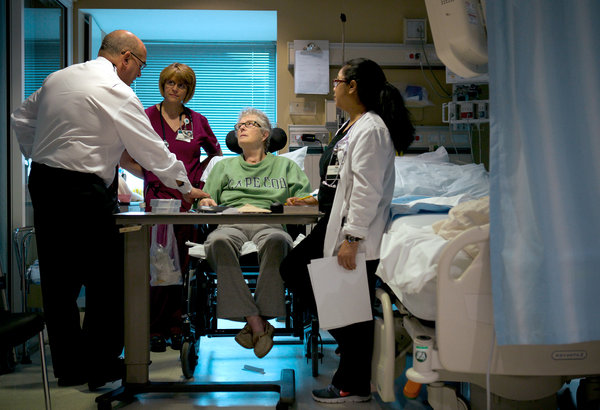
Dr. Paul Scalise, left, of the Hospital for Special Care, with Joy Franklin, a patient, and staff members. "People don't want to think about us," he said. Credit Rick Gershon for The New York Times
"Everybody wants 'the One,' " said Ms. Lavigne. "I did not expect to find him here, of all places."
Other patients face tougher choices. The man with A.L.S. knows he will never eat again, that he will never walk again. He knows that the little muscle movement he has left will go. But it is not easy to pick a day and decide that is the day you will die.
Dr. Scalise visits the patient, who signs and mouths the words that he does not want to live like this any longer. But Dr. Scalise wants to be certain the man is sure. He asks a psychologist, a psychiatrist and another doctor to talk independently to the patient about what he wants to do.
Dr. Scalise, the nurse and the respiratory therapist are haunted by that first difficult conversation. "He does not want to live here, and he does not want to die," Dr. Scalise said. "There is no training that deals with any of this."
The man waits a week, speaking with the other doctors, thinking about how hard it would be to leave his family, including four children, two of whom were still in college. Then he asks the hospital staff to disconnect the ventilator.
On Wednesday, Feb. 27, at 8 p.m., the man's nurses began giving him intravenous medications to deeply sedate him. The next morning, they turned off his ventilator. The man's family was gathered at his bedside. Death followed in about 20 minutes.
"It was very hard to lose him," his wife said. "I think it took a lot of courage."
http://www.nytimes.com/2014/06/24/health/life-goes-on-at-long-term-acute-care-hospitals.html?emc=edit_tnt_20140623&nlid=10672999&tntemail0=y&_r=1
----
Hollywood movie star Toni Collette given advice for role in Miss You Already by cancer staff at Cambridge University Hospitals
By CambridgeNews | Posted: November 07, 2014
By Freya Leng
It is not every day that people get up and go to work and give advice to a Hollywood movie star.
But two specialist nurses and a consultant from Cambridge University Hospitals (CUH) got to do just that.
Neuro-oncology specialist nurse Ingela Oberg, breast cancer specialist nurse Alison Hallett and cancer consultant Dr Richard Baird provided on-set clinical consultancy to Hollywood actress Toni Collette, during the filming of new comedy drama, Miss You Already.
The film follows Milly and her best friend Jess, played by Drew Barrimore, who are lifelong friends who struggle to maintain their relationship when they are both hit by heartache.
Town planner Jess lives a happy bohemian life with her partner Jago - played by Paddy Considine - until she struggles to conceive the baby she has always longed for.
The trio gave guidance to Collette, whose plays character Milly, a high-flyer with two children and a husband Kit - played by Dominc Cooper - whose life is upturned when she develops a brain tumour following the spread of breast cancer.
"Toni and the production team were very keen to portray what it's like living with a brain tumour, as accurately as possible," said Ingela. "They approached me and asked if I could guide Toni on how her character's behaviour might change, and the kind of challenges she should expect to face with an illness like brain cancer."
Ingela, the Trust's only neuro-oncology specialist nurse, recently spoke at the Houses of Parliament on the future of treatment for those with brain tumours including the the lack of appropriate support for younger people leaving hospital with temporary or permanent brain damage.
"I lost my younger brother to a brain tumour", she added. "So improving things for those living with or recovering from brain cancer is something I take very personally."
Cambridge University Hospitals is a specialist cancer centre, covering the East of England, Luton and up to Lincolnshire.
Read more: http://www.cambridge-news.co.uk/Cancer-staff-Cambridge-University-Hospitals/story-24337028-detail/story.html#ixzz3StXzFY9a
http://www.cambridge-news.co.uk/Cancer-staff-Cambridge-University-Hospitals/story-24337028-detail/story.html



Educate the world that nurses save lives!
