

Five Days at Memorial: Life and Death in a Storm-Ravaged Hospital
(2013)
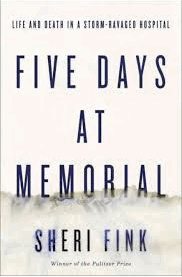
By Sheri Fink
Crown Publishers
| Nursing rating |  |
| Artistic rating |  |
| Rating guide: excellent = 4 stars; good = 3 stars; fair = 2 stars, poor = 1 star |
|
This is a detailed account of the conditions at Memorial Medical Center in New Orleans during Hurricane Katrina. While the author, a physician who has written numerous articles for Pro Publica, notes that she was not physically present during the disaster, she provides detailed notes and references for most of the statements that she makes. She tells readers that she based her story on over five hundred interviews with nurses, physicians, and staff members as well as with government officials, researchers and even ethicists. She lists numerous editors, researchers and fact-checkers in her acknowledgements. In that, it can logically be assumed that this account of the events at this hospital are as accurate as they can possibly be.
Overall, it is a difficult book to read, both in terms of writing structure as well as with the story that is being told. In some chapters, the writing and level of detail are plodding and this reviewer had to re-read sections several times in order for the account to make sense. However, the description of what is alleged to have occurred is chilling and at the very least, should make the reader seriously reflect on two different questions. First, how prepared for disaster is our healthcare system? And, second, how ready are healthcare workers to make very difficult ethical triage decisions?
The first portion of the book describes the conditions at Memorial during the hurricane, their attempts at effecting rescue of patients, coping with lack of electricity and managing patient care under chaotic and deplorable conditions. The dedication of the nursing and medical staff to provide care for their patients is very clear and is told through anecdotes of actual patients at Memorial. However, allegations of possible euthanasia of patients were made and did focus on actions of a physician and some of the nursing staff. The second part of the book describes the resultant investigation of the events and eventual arrests of Dr. Anna Pou and two RNs. The investigation process is presented in a very objective manner.
From an emergency preparedness perspective, there were certainly many questions about facility and corporate communication during the early hours of the hurricane. The author asks, “Were deaths at hospitals and nursing homes regrettable results of an act of nature, a chaotic government response, and poorly constructed flood protection overlaid on a degraded environment? Or had lax oversight allowed individual or corporate greed to play a role? Did some hospital and nursing home leaders decide not to evaculate before the storm, primarily to avoid the substantial costs of emptying and closing health facilities? Were emergency plans not followed, investments not made, and health workers not properly prepared?” These questions should be in the mind of the reader throughout the book.
In terms of ethical decisions and how they might be made differently in a disaster, when resources are truly stretched to the limit, this book does a good job in making the reader think about what they might do should they be faced with conditions such as those faced by the staff at Memorial. Whether or not actual euthanasia did occur, the ethical dilemmas faced by Memorial staff, as well as staff at other facilities during Katrina are real dilemmas and deserve discussion. During Super Storm Sandy, when facilities were faced with evacuation and possible rationing of resources such as ventilators, emergency plans were found to be lacking in terms of making decisions for the greater good. Healthcare experts make assumptions about what is best; however, the public is not often included in development of guidelines for allocating medical resources during disasters, as recommended in a 2012 report from the Institute of Medicine.
This reviewer recommends this book as required reading for emergency preparedness coordinators or managers in hospitals. It is also a story that should interest anyone who is concerned about the “what if”, whether that “what if” is a hurricane, a tornado, an earthquake or mass terrorist event. The questions posed by Dr. Fink are valid – are we ready for another disaster? And when it occurs, will we be able to make difficult decisions?
Reviewed by Vicki Sweet, RN, MSN, CEN, CCRN, FAENMarch 29, 2014
The views expressed herein do not necessarily reflect those of the Board Members or Advisory Panel of The Truth About Nursing.



Educate the world that nurses save lives!
