

 |
News on Nursing in the Media
Always remember to help ladies on with their coats!
 June 29, 2009 -- Tonight's episode of Showtime's Nurse Jackie highlights the expert psychosocial care Jackie Peyton and her nurse colleague Mohammed (Mo-Mo) de la Cruz give to ED patients and families. No one could mistake these nurses' thoughtful, sensitive care for unskilled hand-holding. The episode also suggests that physicians are often less adept at these tasks, even though they may receive all the credit from those the nurses have helped. Once again, the show's nurses play a central role in patient care, and Jackie ably trains more junior health team members. At the same time, the episode features a remarkable scene in which a school nurse goes head to head with Jackie about whether Jackie's daughter has a potentially serious anxiety disorder that may require medication; both of them seem to have valid points. One less impressive aspect of the episode involves Jackie ordering the removal of a patient's non-disruptive mother and twin brother from a trauma room without asking if they want to stay, just like the physician characters in other hospital shows do, with no hint of the potential benefits of family presence. This fourth episode, "School Nurse," was written by Christine Zander. more...
Take Action!
 July 9, 2009 -- In the June 4, 2009 premiere of USA Network's new hit summer drama Royal Pains, the brilliant and heroic physician character Hank Lawson was fired and blackballed by a New York City hospital for treating all patients equally. Afterwards, Hank lamented that he could not even find a job as a school nurse! (See the Quicktime clips at broadband or dialup speed.) The message for the episode's 5.6 million viewers was that there could not be a more trivial and unskilled job for a health worker than that of school nurses, who presumably spend their days placing band-aids on scraped knees. But in fact Hank could not get a job as a school nurse because he has not spent years in nursing school, has no nursing license, and knows little about nursing. While the contempt in this episode continues to infect the mass media, it's no surprise that real school nurses struggle for the resources they need to save lives and improve student health. Ryan Blackburn's May 8, 2009 story in the Athens Banner-Herald (GA) explained that school nurses manage chronic health issues like allergies, diabetes, and seizures so students can continue learning. Anemona Hartocollis's April 28 New York Times article described the work of New York City school nurse Mary Pappas. She became "a sort of folk hero to nurses" for setting in motion the governmental response to the October swine flu outbreak, identifying and managing hundreds of students' symptoms in a way that might even impress Hank Lawson out in the Hamptons! And today the Associated Press ran an excellent item by Lauran Neergaard about Pappas's "riveting" performance at the Obama Administration's swine flu summit.
  There the nurse explained how she handled the huge triage challenge in October, and her plans for the coming flu season, offering this pointed advice to the government: "Every school needs a nurse." Kris Sherman's March 8 article in the News Tribune (Tacoma, WA) offered a tragic example of what happened in that same October at a local school with no nurse: A fifth-grader died from a massive asthma attack, even though she was taken to a school health room where materials were reserved specifically to save her life. No one with significant health training was there to use them. These recent press pieces paint a picture of a vital professional specialty worthy of more than the undervaluation that has strained its members beyond the breaking point--and that continues to take our children's lives. We urge everyone to help change that situation. Join the National Association of School Nurses in the effort to pass the student to school ratio improvement act and ask your organization to join their list of supporters. more...and take action to support school nurses!
 June 9, 2009 -- Tonight's episode of Fox's summer drama Mental illustrates the peripheral subordinate role played by the show's one recurring nurse character. It also reminds us that, despite the two nurse-focused summer shows that have received recent attention, physician-centric shows like Mental and USA Network's hit Royal Pains continue to attract many more total viewers--especially if you count the summer re-runs of Fox's House and ABC's Grey's Anatomy, Private Practice, and Scrubs. Mental is essentially a variation of House. In both shows, a brilliant hospital physician uses unorthodox, at times outrageous methods to diagnose and treat challenging conditions, amazing his less gifted fellow physicians and earning the tolerance of a long-suffering female boss. The twists in Mental are that the patients all have psychiatric problems, so instead of inside views of patients' bodies, we explore the troubled patients' minds. Also, Mental's lead character Jack Gallagher is charming and social, rather than a witty but obnoxious loner. Jack and four other physician characters provide all important patient care, including psychosocial care. Nurse Malcolm Washington does care about the patients. In one scene here, he reports a basic symptom, one that anyone would notice. In another scene, he briefly advocates for the patient, making a point that is understandable but uninformed. In general, he seems to be on hand to perform basic physical tasks and keep patients company, as Jack puts it at one point. And Malcolm's manner is more that of a faithful assistant than a college-educated professional. The episode, "Book of Judges," was written by co-creator Dan Levine and drew 4.7 million viewers. more...
 June 2009 -- A recent article in the Colorado Springs Gazette highlighted the continuing problem of physician abuse of nurses in some care settings. John Ensslin's June 26 piece was "Nurse sues Memorial, claims surgeon threw human tissue at her." The story reports that in mid-2008, Bryan Mahan, the chairman of cardiac and thoracic surgery at Memorial Hospital, allegedly threw and hit operating room nurse Sonja Morris with a 4-by-6-inch piece of bloody tissue (the pericardium), and committed other physical assaults on her. Morris says she complained to the hospital with no result, then filed a gender discrimination claim with the U.S. Equal Employment Opportunity Commission. Morris says hospital administrators soon transferred her from the heart surgery team to the main operating room, which is considered less prestigious. She finally filed suit in federal court against the hospital--but not Mahan--on the grounds that she was demoted for complaining about the abuse. Commentary from local nurses posted on the Gazette's web site in response to the story suggests that physician abuse of nurses has been tolerated at the hospital, and that one reason for such tolerance is money. Since physicians are viewed as vital revenue generators, there is a strong incentive to ignore or excuse their misconduct. Of course, patients could not survive surgeries without nurses, and physician abuse of nurses is a major threat to that survival as well, since it is difficult for abused nurses to perform their work as effectively. In addition to economics, the historic power imbalance between the two professions, and between the two genders, would seem to play a role in the cycle of abuse and impunity as well. The Gazette might have provided more context and detail, but we thank the paper and the nurses who responded for drawing attention to these important issues. more...
 June 30, 2009 -- Tonight's episode of TNT's HawthoRNe again presented the lead character as an authoritative chief nursing officer who fights for patients and families. Hawthorne tries to solve problems in creative ways, notably in using hospital systems to give a grieving man time to say goodbye to his brain-dead mother before her life support is disconnected. The new nurse Kelly, who is very meek, does manage to show some skills and to solve an important health care mystery, determining the surprising cause of an infant patient's ingestion of a toxic substance. And nurse Ray forcefully explains to a patient that he is a trained professional, though not until he has spent an entire shift letting her treat him like a servant. And his speech about nursing does show that he is still a wannabe physician. Indeed, the show seems to focus on nursing weakness, and what nurses lack the authority to do. Perhaps the most striking problem is that the episode finally makes clear that Hawthorne reports to the chief of surgery. This plays out in a horrific scene in which the hospital CEO criticizes the chief surgeon for failing to control "this nurse," i.e., Hawthorne, who stands by, essentially silent. This wrongly suggests that nurses, no matter how senior, automatically report to physicians, and by extension, that nursing is merely a subset of medicine. The episode, "Yielding," was written by Sarah Thorp. more...and please speak to the producers.
 April 6, 2009 -- Recent press articles have told the stories of people in different parts of the world who mix nursing and art in ways that may serve both fields. On March 10, the Yuma Sun (Arizona) posted Geovana Ruano's profile of the experienced Mexican nurse and poet Beda Laura Domínguez, "A poet in search of love." And today, the Philippine Daily Inquirer posted Tony Maghirang's "Double life: Rapper wants to be a nurse," a portrait of a popular rapper who, despite having a stage name based on a gun, is in his third year of nursing school. Although the Yuma Sun piece does not have much about nursing, both profiles say that their subjects have incorporated aspects of nursing into their art, potentially conveying information about the profession in an engaging way and suggesting to the public that nurses are articulate observers of the human condition. more...
 See President Obama's July 15, 2009 Rose Garden speech about nurses and health reform
We will post an analysis of President Obama's speech involving nursing in a later news alert. In the meantime, please see the video of his speech on YouTube.
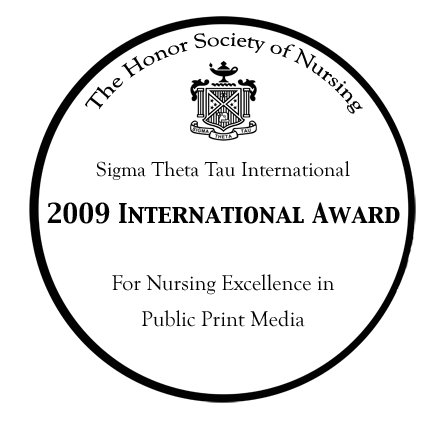 Saving Lives to receive 2009 International Award from Sigma Theta Tau
July 16, 2009 -- The book Saving Lives: Why the Media's Portrayal of Nurses Puts Us All At Risk will receive the 2009 International Award for Nursing Excellence in Public Print Media from Sigma Theta Tau International, the Honor Society of Nursing, at the group's biennial convention this fall.
The good, the bad, and Zoey's stethoscope
 June 22, 2009 -- Tonight's episode of Showtime's Nurse Jackie continues to present Jackie as a clinical leader with a vast skill set, and to show that nursing can be as compelling as medicine--if you actually let nurse characters do the nursing, as no other major show has done on a regular basis. Here, Jackie provides skilled care to a dying heart patient and a young woman who has become addicted to Vicodin. She also joins her best friend, physician Eleanor, in an amusing but deceptively important effort to teach nursing student Zoey not to be intimidated by physicians. One of the most impressive aspects of Nurse Jackie is that it goes out of its way to show not only that Jackie is clinically expert and a strong patient advocate, but also how patients and their families benefit from her advanced psychosocial skills. These are all the more amazing given her somewhat raw approach to colleagues and the addiction to painkillers that seems to haunt her. Small parts of the episode do reflect what may be the show's most significant ongoing problem, its iffy portrayal of nursing autonomy and authority. Jackie's interactions with physician Coop suggest she has little idea about what the hospital's upper management structure is--it seems to consist of the physicians. And the episode's depiction of Jackie's boss Gloria Akalitus tells viewers that nurse managers are not really nurses. On the whole, though, the episode offers another engaging look at what a strong, skilled nurse can do for patients. The episode, "Chicken Soup," was written by Mark Hudis. more...
 April 17, 2009 -- Today the Cape Cod Times ran a very good article by Cynthia McCormick about the challenges nurses face in discussing spiritual issues with patients. The report describes a recent incident in which a per diem nurse at Cape Cod Hospital upset a patient's family by discussing "repentance" with the dying patient in a way that allegedly distressed the patient. "Spiritual talk by nurses spurs soul-searching" explores the nature of that incident through quotes from the nurse and others involved, but it also sets the issues in context by consulting a local nurse expert: Kathleen Geagan Ryan, a hospice nurse and ordained interfaith minister. Ryan explains that nurses can provide spiritual counseling by listening and letting patients take the lead, and being sure not to do anything that could be interpreted as imposing their own beliefs, a sensitive thing given the unequal power between nurse and patient. We thank McCormick and the Cape Cod Times for a sensitive report about a difficult aspect of health practice--one that would seem to be even more complex than the report indicates--for nurses who often confront the challenge of helping patients face their own deaths. more...
"Helpers?" The New York Times on Saving Lives
July 1, 2009 -- Today Tara Parker-Pope's "Well" blog at the New York Times posted a very good piece by regular contributor Theresa Brown, RN, about the key issues raised by the book Saving Lives: Why the Media's Portrayal of Nurses Puts Us All at Risk, written by the leaders of the Truth About Nursing. Brown framed her well-written discussion of the book by suggesting that even her beloved New York Times crossword had reinforced "outdated nursing stereotypes" by referring to nurses as "white-cap wearers" and "I.C.U. helpers." The Times deserves credit for publishing a piece framed by a critique of one of the paper's own prominent features. Brown explained that the book argues that the media's heavy reliance on nursing stereotypes, particularly in Hollywood television shows, can undermine nursing care by reducing the attention we pay to vital issues like short-staffing.
Saving Lives is an important book because it so clearly delineates how ubiquitous negative portrayals of nursing are in today’s media... [The authors] argue that these images of nursing degrade the profession by portraying nurses as either vixens, saints or harridans, not college-educated health care workers with life and death responsibilities. The problem with how nurses are portrayed in the media is that it has the potential to devalue the way we view nurses in the real world.
We thank Theresa Brown, Tara Parker-Pope, and the New York Times.
See the full article, "Why Nurse Stereotypes Are Bad for Health," and take a look at the numerous and varied comments that follow at the "Well" blog. Please weigh in on this interesting discussion! Some of the comments so far suggest a need for further education about nursing autonomy and the value of nursing (e.g., #44).
Other Truth About Nursing press coverage
Los Angeles Times -- Marc Siegel's bimonthly column The Unreal World featured quotes from our executive director Sandy Summers in his piece, "Few Nurses are 100% Jackie," published on June 29.
ADVANCE for Nurses -- Ainsley Maloney's article Nurse Jackie & HawthoRNe: How two new primetime TV shows are expected to portray the nursing profession to the public, features many quotes from Sandy Summers in its June 24 - July 8 edition.
Cape Cod Times -- On June 11 Cynthia McCormick discussed our book Saving Lives in an article "Nurses sidelined in TV medical dramas." It was reprinted in The New Bedford Standard Times on June 25.
 June 16, 2009 -- Tonight's series premiere of TNT's hospital drama HawthoRNe makes a serious effort to tell stories from a nursing perspective and to focus on nursing care, particularly the exploits of the dedicated, expert, and strong chief nursing officer Christina Hawthorne (Jada Pinkett Smith). Remarkably, the show has four diverse major nurse characters--including the black female lead and a man--with just one major physician character. This is an unheard-of TV ratio, though a good approximation of hospital reality. Indeed, the very fact that HawthoRNe shows that chief nursing officers exist is helpful. Nurses are not interchangeable widgets, and some here are clearly more skilled than others; to some extent they provide autonomous care. In several cases the pilot gives viewers a sense of the lack of respect nurses often receive from patients and physicians. And it suggests that nurses have the skill and perhaps even some obligation to resist physician "orders" in order to protect patients. One nurse questions but still gives an erroneous physician insulin prescription, then gets in trouble when the patient crashes. But sadly, the overall portrayal does not convey enough of nurses' real skill or autonomy, and elements of the episode reinforce harmful stereotypes. The nurse-physician conflicts do not really make clear that nurses are legally and ethically obligated to resist dangerous physician care plans. Many scenes suggest that the direct care nurses are, well, weak, and very much in need of rescuing by Hawthorne. As on other shows, the blistering contempt of some physician characters is not adequately refuted, except to some extent by Hawthorne herself. And surely nursing does not need an image of a frustrated nurse who really, really wants to be a physician but was unable to get into medical school, and so harbors a huge inferiority complex. Surely we don't need an image of a beautiful young nurse named Candy who thinks it's part of her job to grant sexual favors to Iraq War veterans as a "thank you" for their service, and who we see cheerfully provide manual sex to a soldier in the pilot. And at times, the show suggests that staff nurses tend to be frivolous physician helpers--physicians still do both defibrillations we see. HawthoRNe may not inspire a lot of critical respect, but its main character and basic structure could help nursing a great deal, so we hope future episodes will avoid stereotypes, and do more to convey what nurses do to save lives. The pilot was written by series creator John Masius. The first episode was seen by 3.8 million viewers. more...
Take action!
 April 27, 2009 -- Today's New York Times Crossword puzzle sought the answer "nurse" with the clue "hospital attendant." But nurses are skilled, autonomous professionals who use their years of college-level education to save lives and improve patient outcomes. They are not "attendants," a word which is generally used to mean an assistant or service worker with relatively little formal education in the relevant field. The clue recalls the Times Crossword's even more inaccurate February 2007 nurse clue "ICU helper." Of course, some will note that it's "just a crossword puzzle." But all mass media has some effect on how people think and act. And the fact that the premiere crossword in the world repeatedly features such clues illustrates the range of media that contributes to the deadly undervaluation of nursing, and of course, also shows how difficult it is to correct such stereotyping. This puzzle was created by Joe Krozel, and the current Times puzzle editor, as in 2007, is Will Shortz. more... and please join our letter-writing campaign!
Dear Readers:
Below is our review of the first episode of Showtime's new television show Nurse Jackie. Please consider that what Nurse Jackie says about nursing is far different from what it is saying about its main character. We urge you to keep an open mind and watch the show in full. We know not all readers will agree with our review. Even so, we are hoping that nurses will use the show as a vehicle to teach friends, family and society what nursing is, what nursing is not and what nursing could and should be. A powerful, critically-acclaimed nurse-centered television show has been a long time coming. Let's use what we can from it to change how the world thinks about nursing. Thanks for tuning in.
Sandy Summers, Executive Director, The Truth About Nursing
Make me good, God. But not yet.
St. Augustine; Nurse Jackie

June 8, 2009 -- Tonight's series premiere of Showtime's "dark comedy" Nurse Jackie is a brutal subversion of the unskilled angel stereotype. The first significant nurse-focused show to emerge from Hollywood in more than 15 years, Nurse Jackie may be the strongest--though not most positive--fictional TV portrayal of a modern nurse that we have ever seen. Jackie Peyton is a New York City ED nurse. Like esteemed TV physicians Greg House (Fox's House) and John Carter (NBC's ER), Jackie is a high-functioning drug addict. But she is also a tough, life-saving nurse who works at the center of patient care, and the show is unusually alert to what nurses experience. Jackie displays formidable clinical expertise, advocates forcefully to save a patient from an arrogant young physician (though she does not save that patient), and provides adroit psychosocial care to patients and families, as well as tough love mentoring to an innocent nursing student--and the physician. Also, she is a major wit. Jackie is not a role model in some respects. To treat a bad back, she takes powerful painkillers that she gets illegally from her pharmacist boyfriend. She has sex with him in the hospital pharmacy. She forges an organ donor card after a young patient dies. She flushes a diplomat's severed ear down the toilet upon learning that he will not be prosecuted for a vicious assault on a prostitute. She steals a wad of the diplomat's money and gives it to the organ donor's impoverished, pregnant girlfriend. And viewers may not get that it was her job as a nurse (not just as Jackie) to protect her patient from the physician; they might wrongly assume that physicians are ultimately in charge of patient care, and Jackie is just unusually assertive. But nothing else here reinforces the stereotypes that have led the public to undervalue nursing. Jackie is deeply flawed, like real people, but she is not a brainless physician helper, a naughty nurse, or an angel, though the nursing student  calls her a "saint." Since Jackie seems to leave few Commandments unbroken, "God's rogue henchman" might be closer to the mark. She is like a Jack Bauer (24) of the ED (Jackie Bauer!), an extraordinary operative doing things she has no real right to do so she can achieve her vision of social welfare. Still, there is more intelligent life in this pilot than in a whole season of some hospital shows, and Jackie may well end up as one of the most important fictional nurses in history. The episode was written by series creators Liz Brixius & Linda Wallem and Evan Dunsky. more...
Please see our full review here!
See Truth About Nursing press coverage on "Nurse Jackie"
St. Petersburg Times (Florida) "Hawthorne and Nurse Jackie give a different view of nursing" by Eric Deggans, June 7, 2009.
HealthLeaders "Skepticism and Some Optimism Surround New Nursing Dramas" by Keri Mucci, June 4, 2009
Summer 2009 TV Preview
May 24, 2009 -- This summer Hollywood will unveil four new fictional health care television shows, an unusually high number. But what's even more striking is that two of the shows--Showtime's Nurse Jackie (premieres June 8) and TNT's HawthoRNe (June 16)--will be the first significant nurse-focused shows to emerge from Hollywood in more than 15 years. These two shows appear to feature strong central nurse characters: Jackie (right) is a New York City ED nurse played by Edie Falco, and Hawthorne is a chief nursing officer played by Jada Pinkett Smith. And although we can foresee some issues with the two shows, there is cause for hope that they--along with NBC's Mercy, a nurse-focused regular season drama that will reportedly air in mid-season (est. January 2010)--may do what we have been urging Hollywood to do since 2001: convey more of what nurses really do to save lives and improve outcomes. The pilot episode of Nurse Jackie is one of the best (though not most positive) fictional TV portrayals of a nurse that we have seen. The other two new summer shows, Fox's Mental (May 26) and USA's Royal Pains (June 4), are in the traditional physician-centric mold. Mental, about a maverick LA psychiatrist, has one recurring nurse character to support the five physicians who will likely dominate. And Royal Pains is about a brilliant, hunky, good-hearted "concierge doctor" in the Hamptons; it appears to include no nurse characters. Of course, even if the new nurse-focused shows do offer better portrayals of nursing, Nurse Jackie and HawthoRNe are summer cable shows, which reach a far more limited audience than regular season broadcast shows and run only half as many episodes. As with any new show, there is no guarantee they will last long. And it would take a lot to counter the hundreds of hours of persuasive disinformation about nursing conveyed to millions around the world by popular hospital shows like House and Grey's Anatomy, to say nothing of the many damaging portrayals in non-health care shows like Law and Order: SVU and Desperate Housewives. In fact, even with the perhaps unprecedented event of two "nurse shows" premiering within a week of each other, there are still more major physician characters than nurse characters in the four summer health shows. Still, there is always hope. Tune in and see what happens. more...
A cat has absolute emotional honesty: human beings, for one reason or another, may hide their feelings, but a cat does not.
Ernest Hemingway
 March 16, 2009 -- The main patient in tonight's episode of Fox's House was a nurse who believed that a cat tended to sit with those who were about to die--including, recently, the nurse herself. That may not sound like a promising vehicle for House to improve its abysmal portrayal of nursing. But the show actually presents the nurse as someone with health knowledge. And her search for meaning in faith, for some reason in tragic events, is a real counterpoint to House's cold rationality. Indeed, despite the obvious potential for mockery in the cat angle, the mighty House treats the nurse with considerable respect--he seems to care what she thinks, or at least to find her views unnerving. Of course, the nurse plays no real clinical role in the episode, and no other nurses do either. So the episode suggests, as usual, that physicians provide all important care in hospital settings, including all meaningful psychosocial and physical care. Still, any suggestion that intelligent life resides in a nurse is a welcome departure for House (and for the episode's writer Peter Blake, who also penned a November 2005 House episode that was notable for its physician glorification and its casual contempt for other health professions). Tonight's episode, "Here Kitty," drew 13.1 million U.S. viewers. more... see the relevant film clips... and please join our letter writing campaign!
 March 2009 -- This month we found an unusually high number of press articles from the U.S. and U.K. highlighting nurse-led innovations in health care. A March 1st Birmingham News (AL) story by Anna Velasco profiles a nurse who has founded and managed a health clinic for the homeless under an interstate highway bridge. A March 21 BBC News article by Jane Elliott describes the achievements of a pioneering nurse researcher who showed how to treat deadly bedsores in the 1950's. A March 23 article by Chris Segal in the Panama City News Herald (FL) reports that a local nurse appears on national television annually to raise awareness of the dangers posed by Spring Break, especially those associated with alcohol abuse. And Dee Adcock's March 24 report in the Dorset Echo (U.K.) discusses the work of a group of nursing students to raise awareness of post-natal depression. Some of these pieces are brief, and some have minor problems, but all convey that nurses are critical thinkers who create and implement new care systems that improve patient outcomes. We salute those responsible for the articles. more...
 ROBONURSE:
Serve the public trust
Protect the innocent
Uphold public health
March 25, 2009 -- Today Agence France-Presse reported that Japan planned to develop safety standards for the "robot nurses" it hoped would soon assume a significant role in caring for the nation's aging population. The article was headlined "Japan plans robo-nurses in five years: govt." These "service robots" may play an important role in future health care in industrialized nations, probably even by doing some tasks that fall under the general category of "nursing," such as lifting patients. But "robo-nurses" are not college-educated professionals who save lives with their critical thinking skills. Real nurses are. And the media's chronic misuse of the term "nurse" to describe the robots undermines the profession that actually plays a central role in health care. more...
 March 3, 2009 -- Today The Huntsville Times (AL) ran a generally good story by Steve Doyle headlined "Hourly nurse rounding is a growing trend around the country." The piece focuses on local hospitals that have established programs to check patients on set schedules for comfort, positioning, and other needs. Some programs include requirements that care givers actually introduce themselves and explain to patients what they are doing! The programs reportedly improve patient outcomes, for instance by reducing falls and bedsores, and they also increase patient satisfaction. The article quotes two nurse managers, in addition to "customer service" directors; it might have also consulted the direct care nurses who actually do the rounding. We thank Doyle and the Huntsville Times for a helpful report on these promising trends, which also have the potential to increase the visibility of nurses and public understanding of the importance of what nurses do. more...
"To solve nursing shortage, change attitudes about nurses"
 May 12, 2009 -- Today the Baltimore Sun published an op-ed by Truth About Nursing executive director Sandy Summers arguing that resolution of the nursing crisis will require us to change our preconceptions about the profession. In her "Viewpoint" essay, published to celebrate International Nurses Day, Summers noted some positive recent developments. These include U.S. President Barack Obama's efforts to honor nurses and include them in policymaking, such as by appointing nurse Mary Wakefield to head the Health Resources and Services Administration and increasing funding for programs aimed at addressing the faculty shortage. However, Summers explained, long-term improvement in the clinical and educational resources available to nursing will require a fundamental change in how people see the profession. She pointed out that much of the influential mass media, from popular Hollywood television shows to the news media and advertising, continues to portray nurses as vacuous losers, scut work saints, or disposable bimbos. Only a true appreciation for nurses' life-saving skills can guarantee nurses what they need to meet the health care challenges of the 21st century. As Summers concluded: "Let's celebrate nurses every day by making the only change that will ensure nurses are there when we need them: Let's reconsider the value of what nurses do." We thank the Baltimore Sun. see the full op-ed...
 Wisconsin Public Radio interviews Sandy Summers about Saving Lives
May 7, 2009 -- Wisconsin Public Radio host Joy Cardin did a one hour interview with the Truth's executive director Sandy Summers about our book Saving Lives: Why the Media's Portrayals of Nurses Puts Us All at Risk. listen to the show in Real Player...
 May 6, 2009 -- Tonight, ABC will broadcast what seems to be the series finale of the irreverent sitcom Scrubs; the show may return next season without some central characters. For eight years (the first seven on NBC), the show has imagined what it might look like if a hospital were staffed by gifted insult comics with soft hearts. Like ER, which ended its far longer run just last month, Scrubs has been a highly physician-centric show that has included one major nurse character. That has always been Carla Espinosa (played by Judy Reyes), a no-nonsense, relatively normal bedside nurse who has at times been said to have a management role. Espinosa has generally been presented as a smart, skilled nurse with some leadership qualities. And the show has at times underlined her knowledge and good judgment, even showing her teach junior physicians. She is married to the new chief of surgery Turk, and she has long been perhaps the closest friend of the ornery chief of medicine Perry Cox. Despite all those connections, however, the show has (contrary to fact) made very clear that as a nurse, Carla reports to physicians, and that physicians are ultimately in charge of all aspects of patient care. The show has also featured extensive physician nursing, in which physicians do important care tasks that nurses generally do in real life, like bedside monitoring and psychosocial care, an enormous theme on Scrubs. Even so, the show has clearly been better for nursing than popular newer dramas like ABC's Grey's Anatomy. So tune in Wednesday, compose a wishful J.D.-style daydream in which the best Scrubs nursing moments were representative of the show as a whole, and give the show a not-so-bad five! Read more about Scrubs...
Seeking some firebrand: Nursing Standard reviews Saving Lives
 April 29, 2009 -- This week's issue of Nursing Standard, the U.K.'s best-selling nursing journal, included Dame Betty Kershaw's review of Saving Lives: Why the Media's Portrayal of Nurses Puts Us All At Risk. Dame Kershaw (right) is the education adviser of the Royal College of Nursing. She gave Saving Lives 4 out of 5 stars. In her review, Dame Kershaw emphasized that although the book is a U.S. text, "every nurse should recognise the damage that negative portrayals of nursing in the press, films, television and even books can do to our image." Indeed, she noted, the "[t]he popularity of transatlantic film and TV shows means many of the United States images referred to here are seen in the UK." Dame Kershaw explained that "this well-researched text explores the negative effects of adverse publicity and how it inhibits our professional growth," and that the "constant failure to credit nurses for the work they do is addressed." She concluded: "The book deserves wide reading. Hopefully some firebrand may even be driven to duplicate this study in the UK." We thank Dame Kershaw and Nursing Standard. see the full article...
 April 29, 2009 -- ABC's Private Practice, whose season ends tomorrow, April 30, may be the only broadcast network show with a major nurse character to return next season. In the February 5 episode (Mike Ostrowski's "Acceptance," 13 million U.S. viewers), lone nurse character Dell Parker, who is studying to be a midwife, shows some tentative clinical aptitude and knowledge to go with his boyish eagerness. Under the close supervision of OB/GYN Addison Montgomery, Dell ably performs a vacuum-assisted delivery. Later he haltingly guides the baby's parents toward breastfeeding. Dell also performs an assured solo ultrasound of pregnant psychiatrist Violet Turner, calming her panic attack and eliciting her agreement to his own suggestion that, though he's "not a doctor," he will likely become a "pretty good midwife." The show still condescends to Dell, who is also the office manager/receptionist at the LA clinic where the show is set. In the March 26 episode (Craig Turk's "Do the Right Thing," 10.1 million U.S. viewers), Dell starts hooking up with young women by pretending to be a physician. This earns quietly amused derision from the elite physician characters. Of course, neither registered nurses nor physicians are qualified to do the job of the other group. But aspiring advanced practice nurses, who may be wrongly perceived as "wannabe" physicians, would be unlikely to reinforce that impression, which would suggest a lack of respect for nursing and themselves. Needless to say, Private Practice remains physician-centric, with its many physician characters often doing key care tasks that nurses generally do in real life. Still, on balance, the early 2009 episodes seem to represent a small step forward in the show's portrayal of nursing. more... see film clips of the show and please join our letter-writing campaign!
Are you a "doctor doctor" or a "doctor nurse"? The confusion is killing me!
 April 2009 -- Recent news items illustrate important aspects of the nurse practitioner experience today. A February 22 report on National Public Radio's All Things Considered provided a basic look at the doctorate of nursing practice degree, and even allowed articulate nurses to explain its value. However, parts of Sally Herships's piece appeared to accept unsupported physician claims that calling nurses "doctor" would cause confusion or harm patients, despite the absurdity of the supposed linguistic crisis. Meanwhile, veteran NP and DNP student Diane Caruso published a March 14 op-ed in the Winston-Salem Journal (NC) urging the public to support health care financing reform, in order to enable the 45 million uninsured U.S. residents to obtain care. Caruso refuted some basic arguments of those who oppose reform, but the most powerful element in her column was the story of a disabled patient who has fallen in the cracks of the current financing system. We commend Caruso and the "doctor nurses" included in the NPR piece for their advocacy. more...
See nurse Theresa Brown's blog entries on Tara Parker-Pope's New York Times health blog
Remembering an 'Ordinary' Patient, May 27, 2009
When Cancer Treatment Might Kill You, May 13, 2009
Doctors and Nurses, Still Learning, April 29, 2009
 March 29, 2009 -- This Thursday, April 2, NBC's "ER" will broadcast its series finale, after 15 years of the popular, intense prime time drama about a busy public ED in Chicago. The show has always been physician-centric, with only one major nurse character to balance its 8-10 lead physicians. It has persistently suggested that ED nurses report to physicians, rather than nurse managers. And it has featured a great deal of physician nursing, in which the physician characters provide care that nurses really do, from defibrillation to triage to psychosocial care of patients and families. The show's relative realism and overall dramatic quality has only made these flawed depictions more persuasive to millions of viewers around the world. However, particularly in the last few years, the show has also included some of the best depictions of nursing ever seen on prime time television. Its major nurse character has at times operated with startling clinical skill, and even minor nurse characters have played roles in care that are clearly more important and realistic than those seen on any other recent network show. Episodes broadcast over the last few months illustrate all of these features. So on the occasion of the show's farewell, we discuss several of these plotlines as a tribute to what may well have been--for all its flaws--the best major U.S. network show ever for nursing. more...see film clips from the three episodes!
Against everything she has been taught
 March 22, 2009 -- Today the Sunday Times (U.K.) ran a long feature by Amy Turner about the harm that used needles cause in India, where they kill an estimated 300,000 people each year. Most of the piece is devoted to general discussion of the problem, with comment from corporate and non-governmental officials involved with global safe injection efforts. But there is also the story of a nurse at a Delhi hospital who is deeply distressed because she regularly gives injections with used needles she knows are unsafe. Apparently she does so because she feels it would be pointless--and endanger her employment and social situation--to question the revered physicians and hospital managers who insist on the practice. The report does not explore potential measures to address that power imbalance, focusing instead on technological efforts to reduce the epidemic, mainly "auto-disable" syringes. It would have been useful for the reporter to interview not just a guilt-ridden nurse, but also a physician who might defend the use of such needles or otherwise comment. But the piece does highlight one striking example of the harm to global health that occurs when nurses feel they lack the power to advocate effectively for their patients. We thank Ms. Turner and the Sunday Times. more...
 March 17, 2009 -- On February 15, 2009, the Seattle Post-Intelligencer ran an op-ed by nurse Kathleen Bartholomew that used recent layoffs at a local hospital as a vehicle to urge the public to rethink the way the United States provides health care. The op-ed is "We all hurt when hospitals shrink themselves into budgetary compliance." It says that the layoffs of "200 personnel" and the elimination of the chief nurse position at Swedish Medical Center will greatly undermine the infrastructure on which already-stretched direct care nurses and physicians depend. Bartholomew argues that essential support for health practice is crumbling in hospitals because the U.S. regards health care as a business rather than a right, and because the nation misallocates precious health care resources. Results include "long-term higher costs along with health care workers and leaders losing heart," with nurses bearing much of the burden. Sadly, one month after Bartholomew's op-ed appeared, the Seattle Post-Intelligencer itself shrank into budgetary compliance, and the paper delivered its last print edition today. We thank Bartholomew and the Post-Intelligencer for this powerful op-ed, which also shows that nurses are strong, expert patient advocates. more...
Take Action!
A Short History of Dr. Feelgood
 March 16, 2009 -- Today the veteran metal band Motley Crue got coverage in the rock press by arriving for a New York City press conference to announce its summer 2009 Crue Fest 2 Tour in a classic Cadillac ambulance with two women dressed in naughty nurse outfits. The ambulance and nurses underlined a central theme of the tour, which is that the band will play its popular 1989 album Dr. Feelgood all the way through at every show. But it's still a predictably lame reinforcement of the naughty nurse stereotype, which despite being a "joke" degrades nursing in the public consciousness and undermines nurses' claims to adequate respect and resources during a critical nursing shortage. Why predictable? Because the band has not been able to resist the naughty nurse in recent publicity efforts, including as a 2007 promotional theme for frontman Vince Neil's West Palm Beach club "Dr. Feelgood's," as well as in drummer Tommie Lee's appearance as "Dr. Feelgood" in Keith Anderson's 2005 "XXL" video. It's not clear if the naughty nurses will be along for Crue Fest 2. But since the band is stressing that its shows are a way to help fans cope with the lousy economy, maybe it would consider applying that laudable concern for public wellbeing to the nursing crisis, and leave the bimbo nurse part out. more... and please join our letter-writing campaign!

Saving Lives -- Educating society about the value of nursing
March 13, 2009 -- Our new book Saving Lives: Why the Media's Portrayal of Nurses Puts Us All at Risk uses striking examples and an irreverent style to explore nursing stereotypes from TV shows to the news media. We hope every nurse will read it and consider the role the media plays in nursing today--and how we can improve the profession's public image. But the book also explains nursing in compelling terms to the public and decision-makers. We want as many non-nurses as possible to read it. Click here for some ideas to spread the word about nursing and the media.
"The first nurse who saved my son's life": Newsweek reviews Saving Lives
 March 9, 2009 -- This week's Newsweek includes an excellent "Health Matters" article by senior editor Jerry Adler headlined "The Nurse Will See You Now." Adler's focus is how the care his son received for years after his birth with a malformed jaw, which included more than 40 significant surgeries, showed Adler how critical nurses are to health care. Adler writes that "over the years we saw firsthand the truth behind a new book, Saving Lives, by Sandy Summers and Harry Jacobs Summers: that nurses, in fact, perform much of the direct patient care that the media, especially hospital shows on television, routinely attribute to the much more glamorous profession of doctor." Adler notes that many collaborative professions do not receive their due from the popular media, "[b]ut Saving Lives has a serious point, that the devaluation of nursing--both by overlooking nurses' contributions to positive outcomes for patients, and more subtly by emphasizing their devotion, compassion and self-sacrifice over their lifesaving skills--discourages students from the field and contributes to a critical nursing shortage." Adler even "tests" and confirms our thesis with an examination of the physician-centric anthology of interesting cases in surgeon Sherwin Nuland's The Soul of Medicine. Adler closes with a "small tribute to the nurses who kept my son alive for so long" in the recovery room, ICU, and pediatric floor after his many surgeries, most at the Institute of Reconstructive Plastic Surgery at New York University (we might add that OR nurses kept his son alive during the surgeries). We thank Adler for his perceptive and heartfelt article. see the article...
"Obama against foreign nurses"
March 8, 2009 -- Many reports about the White House Forum on Health Care held on March 5 described key elements of the continuing U.S. nursing shortage and some proposals to address it in the early days of Barack Obama's presidency. Today Will Dunham's generally good Reuters piece discussed remarks that President Obama made about the importance of nursing and the need to resolve the critical faculty shortage. "U.S. healthcare system pinched by the nursing shortage" also included comments from U.S. Rep. Lois Capps, who is a nurse, as well as from nursing work force experts. A March 6 report on India's Sify News site had some of the same basic information, with a stronger focus on the effect proposed measures might have on nurses who have been emigrating from Asia to the U.S. to take jobs available during the shortage. The Sify article was shorter, but it did have quite a headline: "Obama against foreign nurses." In fairness, Obama appears to have said only that it makes no sense for the U.S. to "import" foreign nurses. But reports like this do suggest the complex global nature of the nursing shortage. more...
Start out as a nurse and become a health policy expert!
 February 26, 2009 -- Recent press items have reported that President Obama has named North Dakota nurse and rural health expert Mary Wakefield to head the Health Resources and Services Administration (HRSA). HRSA is a federal agency that works to improve access to care by underserved populations, in part by overseeing roughly 7,000 community health centers. The agency is part of the Department of Health and Human Services, and it will reportedly receive $2.5 billion of the new economic stimulus package to improve health care infrastructure and training. Obama's choice and the press coverage send a great message about the contributions of nursing leaders, though some items suggest troubling underlying assumptions. The Washington Post and Reuters pieces provide a good look at Wakefield's new job and her qualifications. The Associated Press and Houston Chronicle items also have helpful elements, but they include subtle suggestions that her expertise is not a natural outgrowth of her nursing (perhaps it's something she developed after she stopped being a nurse and got serious). However, there is nothing incompatible between nursing and leadership, and the kind of community health work Wakefield does is a major part of the nursing tradition. We congratulate Dr. Wakefield on this exciting new position. more...
The 2008 Truth About Nursing Awards
Rank Best and Worst Media Portrayals of Nursing
 February 16, 2009 -- The Truth About Nursing announces its annual list of the best and worst media portrayals of nurses. Recipients of the Truth About Nursing Awards include NBC's ER, which aired one of the best portrayals in its final year on the air, as well as ABC's Grey's Anatomy and Fox's House, which were singled out for especially poor performance. The Awards highlight media portrayals from around the world that the nursing advocacy group believes deserve attention, for better or worse, during the deadly nursing shortage. See the entire press release or go straight to the full list of awards...
Take Action!
 February 15, 2009 -- Today many press outlets ran a very good Associated Press story by Rasha Madkour about nascent efforts to keep new nurses at the bedside through nurse residency programs. The San Diego Union-Tribune headlined the piece "Amid nurse shortage, hospitals focus on retention." But the article really focuses on the particular problem of helping new nurses adjust to the intense demands of practice through formal, hospital-based training programs. The report gives a good basic sense of some of the major types of residency programs and how they can reduce the remarkably high 20% attrition rate for new nurses in the U.S. The article might have included more detail about features of the longer nurse residencies--which are still just one year--and more context regarding the far more extensive physician residencies, including the billions of dollars in federal government support those receive. We thank Madkour and the AP for this very helpful report on an important but often overlooked factor in the nursing shortage. more...and please join our letter-writing campaign!
 February 6, 2009 -- Today the New York Times ran a remarkably astute "Doctor and Patient" piece in which Pauline W. Chen, M.D., explained the problem of "moral distress," when nurses and physicians feel that they cannot do what is right for patients because of the "competing demands" of the health system that surrounds them. The most remarkable part is that Chen relies mainly on the experiences of nurses trying to protect patients in settings in which physicians and others have more power. Chen describes one of her "closest friends, a brilliant and articulate" nurse who still feels she must resort to indirect statements to express her concerns about the care plans of physicians. Chen even consults a nurse expert on moral distress in I.C.U. settings, referring to her as "Dr. Hamric" (!). The expert, Ann Hamric, urges all concerned to recognize and discuss moral distress, because "[n]o one is going to stay otherwise." We thank Dr. Chen and the Times. more...
 February 3, 2009 -- The two episodes of ABC's Scrubs aired tonight included plotlines that highlighted physician disrespect of nurses, and that even included references to forced overtime. In a major plotline in the first episode, lone major nurse character Carla Espinosa was caught between her close relations with the show's physician characters and her role as "head nurse," a representative of the hospital's downtrodden nursing staff. The show deserves credit for this effort. Sadly, the plotlines were largely undermined by the show's deeply flawed vision of nursing. Key problems were the usual incorrect indications that the nurses report to the chief of medicine, who even makes nursing schedules; that physicians should and do control patient care plans and have no need to justify them to nurses, even when the nurses present an apparently better option; that physician knowledge is far superior to that of nurses, when nurses actually know far more than physicians about many important aspects of patient care; and that the problem with physician abuse of nurses is mainly that it's not nice and creates bad workplace relations, when in fact it endangers patients and contributes to the nursing crisis. The first episode, Dave Tennant's "My New Role," drew about 4.9 million viewers; the second episode, Debra Fordham's "My Lawyer's in Love," drew about 4.7 million. more...and see the film clips.
A nursing pioneer biography by a guest writer
 Clara Barton: Founder of the American Red Cross
By Cole Summers, age 10
(adapted from a class project)
Clara Barton is considered one of the greatest nurses ever. She was a nurse on the battlefield, providing care to soldiers. Clara formed the American Red Cross in 1881. see the full biography...
Help people think about nursing!
 We have created two provocative new flyers, and if you like them, please help us distribute them as widely as possible. The "Not What They Say I Am" flyer sends a message that many media depictions of nurses are not accurate and that nurses object to them, in part because they undermine nurses' claims to adequate resources. This is a key message of the Truth About Nursing, and one explored in detail in our new book Saving Lives. The ironic "Hooray for Hollywood" flyer sends the message that, in our view,
  there has been little for nurses to cheer about in recent Hollywood depictions of their work. Popular TV shows like "House" and "Grey's Anatomy" have repeatedly offered inaccurate and damaging images of nursing, and we hope the flyer will cause those who see it to reconsider those images. The small print on the flyers directs people to our book and The Truth's website to learn more. see the full posters and links for downloading and or request flyers be sent to you...
 February 3, 2009 -- Today the book Saving Lives: Why the Media's Portrayal of Nurses Puts Us All at Risk was released by Kaplan Publishing. Written by the leaders of The Truth About Nursing, the book uses striking examples and an irreverent style to explore nursing stereotypes from TV shows to the news media. It explains how these images affect real-life decisions about nursing. And it offers practical ideas to help improve understanding of the profession--and public health. Saving Lives has won high praise from many leaders in nursing and the media. For every $40 donation you make to The Truth About Nursing, we will send you a signed copy of Saving Lives and send an additional copy of the 350-page book to an influential member of the media who needs to hear its message. You can also order Saving Lives at Barnes & Noble or Amazon, or get it at a bulk discount for your classroom or organization. Please consider helping us raise awareness of Saving Lives by distributing our press release to your local media, and sending this news alert to anyone who might be interested. And please join our campaign to distribute 1000 books to the media by making a $40 donation today. Thank you!
"The nurses have kept me going"
 January 10, 2009 -- Today the BBC News web site posted an article by Jane Elliott about the key role "specialist" nurses have played in the survival of one lung cancer patient, and the need for more such nurses to care for U.K. patients with the disease. Most of the piece describes the experience of insurance broker Donald Sutherland, who was given just three months to live following his diagnosis, but has lived for 13 years. Sutherland could not possibly be more glowing about the "excellent care" the cancer nurses gave him. But he could be more specific, since detailed descriptions of what nurses do are far more valuable in educating the public about nurses than general encomiums are. Sutherland does at least convey that the nurses answered his questions and pushed to make sure he was adhering to treatment and getting the attention he needed at the most difficult points. The article also provides data about the prevalence of lung cancer, and the shortage of specialist nurses relative to comparable conditions like breast cancer. It consults two experts from U.K. lung cancer groups who provide some more information about why the nurses are needed--one points to the "information" the nurses provide--but the comments of the experts also could have been far more specific about what the nurses do. Even so, we thank Elliott and the BBC for a generally helpful piece. more...
In our imperfect state of conscience and enlightenment, publicity and the collision resulting from publicity are the best guardians of the interest of the sick.
-- Florence Nightingale
See more news and media analysis on our archives pages:
/javascript' src='http://www.intensedebate.com/js/genericCommentWrapperV2.js'> ?? ??

| ?? ? | ? ?? ? |
The URL for this page is www.truthaboutnursing.org
© 2008-2009 The Truth About Nursing. All Rights Reserved.