



Trouble handling this nurse
 June 30, 2009 -- Tonight's episode of TNT's HawthoRNe again presented the lead character as an authoritative chief nursing officer who fights for patients and families. Hawthorne tries to solve problems in creative ways, notably in using hospital systems to give a grieving man time to say goodbye to his brain-dead mother before her life support is disconnected. The new nurse Kelly, who is very meek, does manage to show some skills and to solve an important health care mystery, determining the surprising cause of an infant patient's ingestion of a toxic substance. And nurse Ray forcefully explains to a patient that he is a trained professional, though not until he has spent an entire shift letting her treat him like a servant. And his speech about nursing does show that he is still a wannabe physician. Indeed, the show seems to focus on nursing weakness, and what nurses lack the authority to do. Perhaps the most striking problem is that the episode finally makes clear that Hawthorne reports to the chief of surgery. This plays out in a horrific scene in which the hospital CEO criticizes the chief surgeon for failing to control "this nurse," i.e., Hawthorne, who stands by, essentially silent. This wrongly suggests that nurses, no matter how senior, automatically report to physicians, and by extension, that nursing is merely a subset of medicine. The episode, "Yielding," was written by Sarah Thorp.
Hawthorne helps Eddie say good-bye to his mother
CNOs don't report to the chief of surgery...really
Please tell us--and the producers of the show--your thoughts on HawthoRNe!
 Kelly Epson's plotline is perhaps the most helpful overall. In that one, a distraught mother named Mary arrives in the ED with her baby. Bobbie Jackson, who seems to be the charge nurse, gives the case to Kelly. Kelly is hesitant, but she takes the baby and manages to suggest that the infant probably had a seizure. Kelly asks another nurse for an IV, O2 monitor, and blow-by oxygen. Later, the more experienced Bobbie explains to the mother that "febrile seizures are relatively common. But her temperature is 98." Kelly gently asks Mary if the baby may have ingested something. Mary denies that. A resident physician arrives, Kelly gives him a quick report, and he asks for a blood workup and spinal tap to rule out some things. Kelly explains to Mary that they have to check for meningitis, but Mary seems suspicious. Later, Kelly asks Mary if she keeps rubbing alcohol in the house. Kelly notes that it contains isopropanol, which lab tests show the baby ingested, likely causing the seizure. Mary denies that the baby could have gotten at whatever alcohol she may have, which would be in a locked cabinet.
Bobbie and Kelly step away, and Bobbie raises the possibility that Mary simply gave the alcohol to the baby. She tells Kelly that they have to get social services involved. The innocent Kelly is shocked and can't believe the mother could have done that to her own baby. This feeling grows when Mary reveals to Kelly what a conscientious (maybe even too conscientious) mom she is, noting that she even has a lock on her toilet. Mary also cleans the baby with a hand wipe, explaining that she cleans her head to toe, sometimes twice a day, to protect her from germs. Later, as Mary is using yet another wipe, a social worker arrives to discuss the baby's condition. Mary is defensive. Afterwards, the social worker says they may need the police. Kelly is again aghast, but Bobbie persuades her that if there's any doubt, they must err on the side of protecting the child.
Later, Bobbie returns with the social worker--and two police who will apprehend the distraught Mary. Mary drops her purse and they haul her way. But as Kelly is picking up its spilled contents, she notices that Mary uses medicated wipes. Kelly figures out that these wipes contain isopropanol--and that's how the baby ingested it. Kelly confirms with the lab that that would account for the amount in the baby's system. Mom and baby are reunited, and the grateful Mary thanks Kelly, noting that she is the reason the mother is free. Afterwards, Bobbie tells Kelly that she told the mother that Kelly is "our resident Columbo." The young Kelly does not seem to get this reference to the legendary TV detective, but anyway, Bobbie thinks she did a great job.
The fragile Kelly is probably the last character we expected to be comparing to the lead character in Fox's House, but her catch here is similar to House's trademark insights into patient conditions. It shows viewers that nurses are critical thinkers whose keen observations can make a real difference for patients and families. Of course, Kelly spends a lot more of the plotline feeling the mom's pain and expressing disbelief that a seemingly responsible person could do a bad thing. We wish we could say this comes off as skilled psychosocial care, but it really seems more like a naive, immature character who is struggling with the fact that being a professional requires her to confront a big scary world. There is a middle ground--not all new nurses act like they're constantly on the verge of tears and might blow away in a strong wind. Still, Kelly's detective work and Bobbie's steady voice of experience redeem the plotline to a significant extent.
 In another plotline, nurse Ray Klein cares for Dolores Kramer, a very nice older woman who seems to have broken her leg through "extreme biking." Dolores is waiting for her son to visit her at the hospital. Ray asks if she needs anything, and when she says she does, he offers to help with "pain meds, dressing reworked, IV changed, anything." However likely it is that a nurse would list things out like that in nurse-speak, it does tell viewers some important things nurses do. But Dolores does not need any of that. Instead, she has many other requests that do not require nursing skill--her ice water is not very icy, she wonders how to find a movie to watch, and how the shower works. Ray actually accommodates these needs, although with increasing frustration. Finally, Dolores's request that he pick something up from the gift shop sends him over the edge.
Ray: No, no. Dolores, I can't get you anything at the gift shop, OK? You wanna know why? Because I'm not a bus-boy, and I'm not a concierge, and I'm not a cable guy. I'm a nurse, all right? I'm an actual medical professional, in case you didn't know that, and I went to school, and everything. And I may not be a doctor, OK, I may not get to put the MD at the end of my name, but you know, in most cases I know as much as they do, if not more, and I don't see them looking for movie channels. The point, Dolores, is that I would just really appreciate it if you could treat me with the same respect as you do them, and only summon me for actual medical problems, OK?
Dolores apologizes. Later, when Ray checks in, Dolores seems cold. It turns out her son never showed. Ray ends up forgoing getting an after work drink with his colleague Candy--with whom he has been trying to hook up from the start of the show--in order to stay and watch TV with Dolores.
Certainly, the plotline shows Ray providing some good solo interpersonal care, but the big thing is his surprisingly long and spirited defense of nursing as a real health profession whose members know a great deal. Although the speech does not really get into the specifics of what nurses know how to do after they have gone to school, Ray did note several of those things in his initial offer to help Dolores. Unfortunately, the second half of his speech implies that Ray remains a wannabe physician, as the show made clear in the pilot. Obviously he is insecure about not having the MD, and not completely happy about being a nurse. In addition, while his words about nursing knowledge are powerful, it's not so much that nurses know as much as physicians about the same things, but rather that they know a lot about an overlapping but distinct body of nursing knowledge. They are not quasi-physicians or junior physicians. Finally, the fact that Ray actually does seem to spend the shift doing unskilled things for Dolores--which prevents him from helping Candy, who's checking medication expiration dates all shift in a drug supply closet--suggests that he really does have very little skilled patient care to do.
Hawthorne helps Eddie say good-bye to his mother
 Perhaps the main plotline in the episode is about Hawthorne's efforts to allow the grieving Eddie Ramos the time he needs to withdraw his brain-dead mother's life support. In this one, chief of surgery Tom Wakefield tells Hawthorne that a neuro patient needs an ICU bed. Hawthorne says the ICU is full, though Eddie Ramos will soon be there to say goodbye and make the final decision on the life support, which his mother has apparently been on for 10 weeks. Hawthorne assures Wakefield that Eddie just needs a little more time. When the reluctant Eddie finally calls Hawthorne, she turns to Wakefield and says:
It's Eddie, he's downstairs in the parking lot. You think you could come with me and just give him some of that magical medical lingo of yours?
Outside, Wakefield explains to Eddie that his mother has no brain wave activity (we guess that would have been beyond Hawthorne). Eddie still can't do it, and he begs for one more day; Hawthorne gives it to him. Walking back inside, Wakefield tells her she has "neither the ability nor the authority" to decide when the life support is removed, and he wonders what her plan is.
Hawthorne's plan turns out to be to clear the ICU bed by putting Eddie's mother in a small storage room / closet currently occupied by furniture, boxes, and racks. Hawthorne herself--yes, the hospital CNO--converts this storage closet into an ICU room, complete with crash cart, vent, and portable O2. She gets friends in the cafeteria to bribe hospital electrical workers with their favorite foods in order to supply power cables and fix a short circuit. She even provides flowers. Wakefield sees all this and is dubious, but he reluctantly goes along.
But then the patient's previously missing-in-action daughter Esther shows up, outraged that the life support has not yet been withdrawn. She orders that that happen immediately, because that's what her mother clearly wanted. Hawthorne tries to persuade her that Eddie needs more time, but Esther says he doesn't need really it, he just wants to be left out of the process.
Hawthorne: Well, I'm a nurse. I'm not authorized to discontinue life support.
Esther: Then get me somebody who is.
Esther goes directly to the hospital CEO John Morrissey. Hawthorne tries without apparent success to reach Eddie by phone, as she and Wakefield try to find ways to slow things down, with Wakefield calling the ethics committee. But soon we see the CEO and Esther approaching them in the hallway outside Ms. Ramos's room. Morrissey approaches only Wakefield and does not even look at Hawthorne, an extraordinary mark of disrespect from someone who in real life would likely be Hawthorne's direct superior--the superior of someone who herself may manage hundreds of nurses.
Morrissey (to Wakefield): Ms. Ramos here says we're disregarding a patient's health care proxy orders.
Wakefield (gesturing toward Hawthorne): Yeah, we were just discussing--
Morrissey: There's nothing to discuss. The patient's wishes were very clear. This is clearly against those wishes.
Hawthorne: Yes, but there is another--
Wakefield stops her with a look.
Morrissey (moving in close to Wakefield): What the hell is this? You think you know better than a patient's daughter does whether she wants to be kept alive on a machine? Or are you having trouble handling this nurse?
Hawthorne: Excuse me?
Wakefield: I can assure you our chief nursing officer is quite capable of handling herself.
Morrissey: Really? Then why am I here?
Wakefield: I don't know, that's a good question, John, why are you here?
Morrissey: I'm here to make sure we're not sued for malpractice for installing a life support patient in a storage room. Now pull the damn plug, and do it now.
Morrissey leaves, seeming to assure Esther that the life support will be removed. Later, Hawthorne and Wakefield do that together; Esther actually can't watch. Hawthorne apologizes for getting Wakefield in the middle of the situation. Later, Hawthorne does see in a video her own daughter just happens to have made at the hospital that Eddie was in fact able to stop by to say goodbye to his mother while she was still alive.
This plotline does of course present Hawthorne as an advocate for the interests of a family member, and someone with a creative problem-solving approach, though many may snicker at the idea of anyone putting an ICU patient in a supply room. We're not so sure about Hawthorne's patient advocacy if she really has allowed this situation to go on for 10 weeks, though it would presumably depend on the actual text of the advance directive. There might also be issues about whether Esther has the right to override Eddie's wishes at will, which presumably an ethics consult would explore.
We are also concerned about the plotline's implication that finding a "bed" for Ms. Ramos just means finding space and equipment, a very common media misconception (see article about how ventilators will cure flu patients without a thought for their nursing care.) In fact, "finding a bed" means, first and foremost, finding a skilled nurse to care for the patient. If the ICU has "no beds" for a patient, it probably means it does not have the nurses required to care for her. Most hospitals have plenty of empty beds, but putting patients in them would do little good without nurses there to take care of the patients. And no matter what room a critically ill patient like Ms. Ramos occupied, she would not fare well without a great deal of nursing care. For one thing, all that complex health care technology does not run itself. This plotline does not really address where Ms. Ramos will get her nursing care, although we do see two nurses (and a housekeeper) help Hawthorne set up the room and provide care to the patient along with Hawthorne. Maybe we are supposed to think CNO Hawthorne will provide the care herself in her spare moments. The amount of work that went into transforming that room far exceeded what it would have taken to take care of Ms. Ramos in the ICU for another day. We are not sure where all the spare nurses came from.
More broadly, some may object to the show's frequent suggestion that Hawthorne, a CNO, plays such an active clinical role, which of course rarely occurs in real life. It's understandable direct care nurses might object to a depiction suggesting managers do work that direct care nurses actually do, though we doubt that depiction will have a significant negative effect on public understanding of nursing as a whole. For that, the key is generally whether nurses are getting credit for nursing work. As far as the undervaluation of nursing goes, there's a big difference between crediting one nurse for another's work, and crediting physicians for nursing work, which remains one of the most damaging problems in Hollywood's portrayal of nursing.
CNOs don't report to the chief of surgery...really
However, the messages about nursing autonomy are troubling. It's pretty obvious from the way Morrissey acts--including his reluctance to acknowledge that Hawthorne even exists and his reference to Wakefield "handl[ing] this nurse"--that Hawthorne reports to Wakefield. That tells viewers that no matter how high-ranking a nurse manager is, she still reports to a physician, even with regard to her clinical care. By extension, then, nursing is a subset of medicine. And while Wakefield is certainly a master with a human face--and a better defense of Hawthorne's ability to handle herself than Hawthorne herself can muster here--Morrissey's conduct suggests that the CEO could in fact treat the CNO as if she were some unpleasant servant he'd never seen before. And this comes on top of the episode's emphasis on all the things nurses can't do because they lack the authority. Wakefield and Hawthorne both stress that she can't make the decision to disconnect the life support, and Ray is always struggling with what he can't do because he's not a physician.
Of course it is true that physicians as a group have more power than nurses, for a number of reasons, but that does not mean that nurses automatically report to physicians. And it does not mean that the chief nursing officer reports to the chief of medicine (or the chief of surgery, which is what Wakefield actually is). Nurses do work autonomously within their scope of practice. And although Hawthorne has certainly shown that she can stand up to physicians, we might have hoped for a bit more of a response to the contempt displayed by this CEO on a patient care issue about which she felt very strongly. Her reaction here suggests that she did not want to get the chief of surgery--her boss--in trouble.
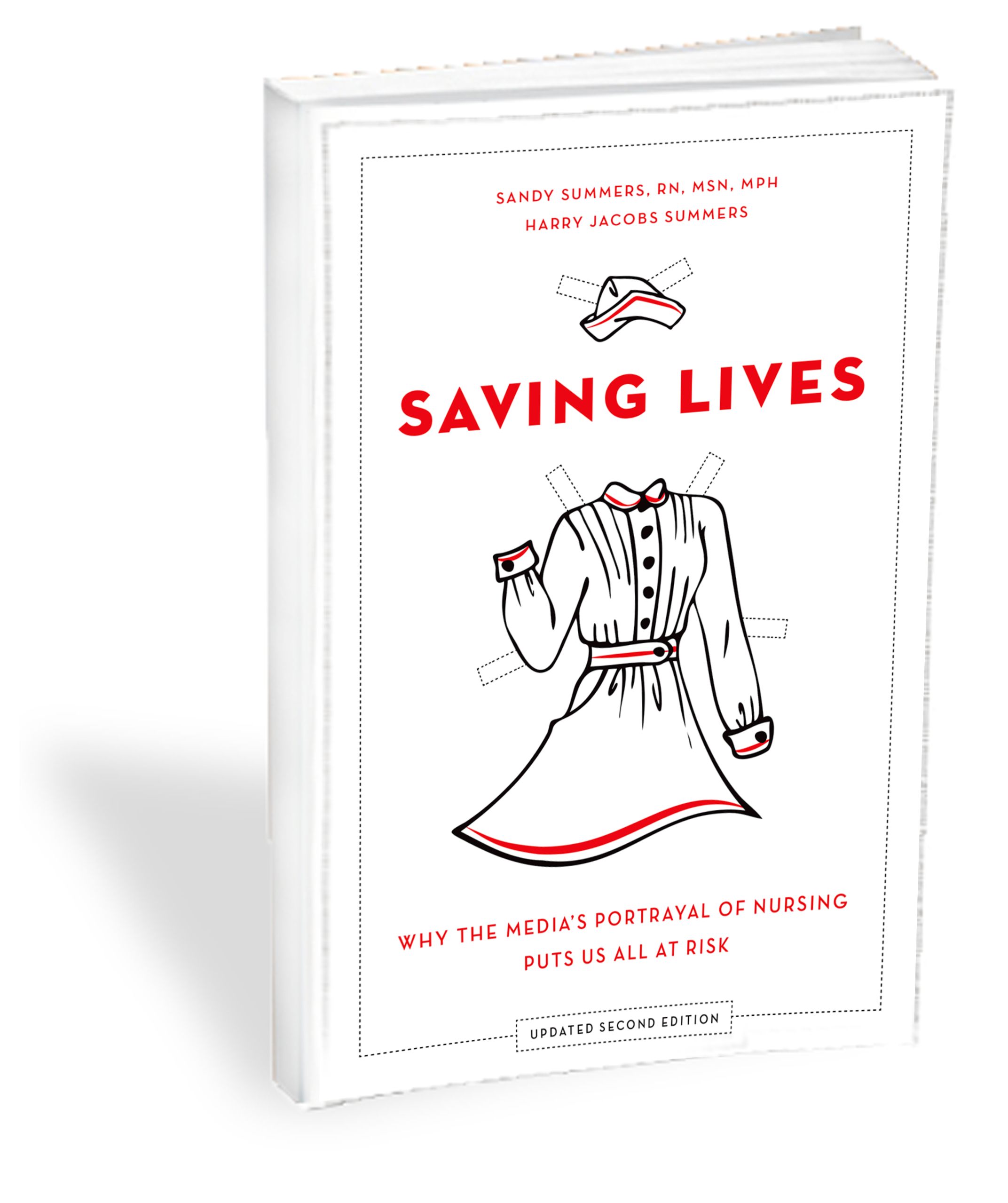
You can read a more detailed discussion of nursing autonomy and the public's understanding of it (with helpful diagrams!) in chapter 4 of our book Saving Lives: Why the Media's Portrayal of Nurses Puts Us All at Risk.
On the whole, this episode offers more mixed messages about nursing autonomy and skill at Richmond Trinity Hospital. But at least the show is making a serious effort to put nurses in the foreground and to explore their issues in a prominent forum. For that it deserves credit.
Please tell us--and the producers of the show--your thoughts on HawthoRNe!



Educate the world that nurses save lives!
